Primer: Pharmacology

These posts, tagged “Primer,” are posted for two reasons: 1). to help me get better at teaching non-scientists about science-related topics; and 2). to help non-scientists learn more about things they otherwise would not.  So, while I realize most people won’t read these, I’m going to write them anyway, partially for my own benefit, but mostly for yours.

Whenever my parents had to try and explain what I was getting my Ph.D. in to their friends or my extended family, the common response would be: “he’s going to be a Pharmacist?” Whenever I’d be asked the question, I’d typically respond with a “sigh” and then continue to say: “The difference is that a Pharmacist sells drugs, and a Pharmacologist makes drugs.” Of course, that’s a simplified definition, but was typically good enough for my purposes.

In actuality, that isn’t completely accurate.  The Dictionary.com definition reads as follows

pharmacology   -noun

the science dealing with the preparation, uses, and especially the effects of drugs.

The Wikipedia article on Pharmacology is also pretty useful, and goes into much greater depth than I prefer to here.  To summarize more broadly, Pharmacology is the study of how drugs work in an organism.  This definition encompasses how a drug gets produced, how it gets into your body, where it goes once it’s in your body, what effect it has once it reaches its destination, and how it ultimately gets out of your body.

According to Goodman & Gilman’s The Pharmacological Basis of Therapeutics (11 ed), the study of Pharmacology can be subdivided into a few different categories, both dependent upon one another.

When a drug enters the body, the body begins immediately to work on the drug: absorption, distribution, metabolism (biotransformation), and elimination. These are the processes of pharmacokinetics. The drug also acts on the body, an interaction to which the concept of a drug receptor is key, since the receptor is responsible for the selectivity of drug action and for the quantitative relationship between drug and effect. The mechanisms of drug action are the processes of pharmacodynamics. The time course of therapeutic drug action in the body can be understood in terms of pharmacokinetics and pharmacodynamics.

So, the study of pharmacokinetics looks at how a drug moves through your body (“pharma” for drug; “kinetic” for movement).  It is important to understand these principles when developing or prescribing a drug.  For example, in the case of sleeping medication, you want the drug to act rapidly in your body so that you fall asleep, however you also want the drug’s effects to last for enough time to keep you asleep…but wear off in time for you to get up the next day.  The study of a drug’s pharmacokinetic properties will help develop treatment regimens that those other doctors (read: M.D.s) can use to prescribe medications accordingly, for whatever the situation calls for.

Pharmacodynamics, on the other hand, looks at how a drug works once it reaches its destination in the body.  Some drugs work primarily in the brain, some in the heart, some in the lungs, and so on.  Many drugs have their function by binding to a receptor on the outside of a cell (example: diazepam [Valium]), perhaps a receptor that is responsible for “exciting” the cell or “depressing” the cell (i.e. increasing a cell’s function or decreasing a cell’s function).  Perhaps Drug A will bind more effectively to that receptor, giving you a more efficient response.  However, maybe Drug B isn’t quite as efficient in eliciting a response.  Along that paradigm, while Drug A may be more efficient, perhaps the desired function by you and your doctor is a more delayed, longer lasting effect, and Drug B could fit that bill (typically, you want anti-anxiety medications to last throughout the day, for example…not just for a few hours).

Knowing principles of pharmacokinetics can help you maximize how much drug gets to the site of action.  Knowing principles of pharmacodynamics can help maximize how much of an effect the drug has once it’s there.  Both of these concepts are essential to effective drug design and usage.

As a brief (yet related) aside, I first became interested in the subject when taking a class on Psychopharmacology in the Psychology department at Truman State.  It was very interesting to learn about how different drugs affect your brain to result in different effects.  For example, a drug like diazepam (Valium) is a drug that’s intended to function as an anxiolytic and sedative.  The basis of its function, however, is that it works on specific receptors that effectively “depress” neurons, limiting their firing ability.  It turns out that function is also quite useful to help prevent seizures, a disorder where neurons fire more often than they should.  So, some drugs that are intended for one purpose can be useful in another, but you need some understanding of how that drug works before you can begin to apply it to another situation.

So, in short, pharmacology refers to the study of how drugs work and, therefore, a pharmacologist works on such things.  I should point out that pharmacists do play an important role in the development of drugs, as well.  Merck and Pfizer employ both Pharmacologists (Ph.D.) and Pharmacists (Pharm.D.), amongst a wide variety of others.

But, they’re quite different in their training.

Five Years

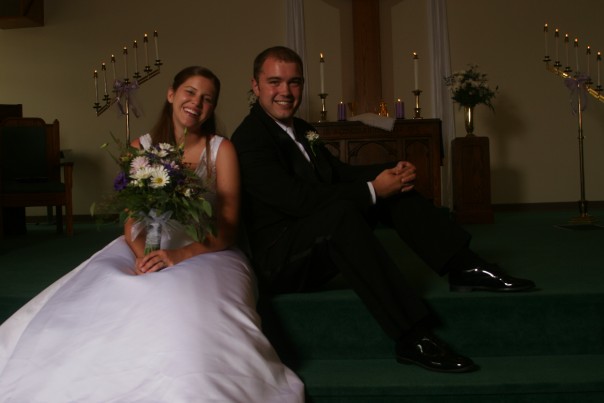
June 25, 2005 was our wedding day.  I’m not going to recount that day in particular (besides pointing out how friggin’ hot it was…), and I’m not going to write anything sappy in this post (as that really isn’t our style).  But, instead, I’m going to highlight a few old blog posts here as a reminder of various important (or less important) events in our lives over the course of the past 5 years.

(I’m doing this partially because I’ve been going through a lot of old posts, “tagging” them to make it easier for me to find in the future.  So, I’ve been reminded of quite a few things over the past few days of doing this!)

…and then…there were two…

“Yup, I’m married…crazy, eh? Brooke and I have moved into our new place in St. Louis and are almost done putting everything where it needs to go…by the end of tomorrow, we should be mostly done…until the next volley of wedding presents arrives this weekend…”

…fun with turtles…

“…and on a side-note, I get to play with my new praise band tonight at Webster Hills UMC…those drums won’t know what hit ‘em…”

Al…most…there…

“Otherwise, Brooke and I are preparing to move to Soulard (neighborhood in the City of St. Louis) from our current apartment.”

…what a weekend…

“Arguably the most pertinent part of the weekend, however, came on Sunday… Brooke and I were wanting to get a pet, so we finally did.”

Miracles Happen

“The moral is that it seems that this thing would have happened no matter what Dad was doing or where he was, so it’s pretty amazing that he was at the fire station with capable people instead of anywhere else.”

Meet Edie

“Well, we found Edith Ann at the Humane Society here in St. Louis yesterday…”Edie” for short…”

Yay!!

“So, I had a spur-of-the-moment interview today with a company called Bridges Community Support Services. It went really well, and at the end of the conversation, the CEO/owner offered me a job as a Community Support Worker.”

Edie: Wonder Dog

“We go downstairs to check out how exactly she got the door open. Apparently, as the picture above shows, she didn’t get the door open – she tore a new hole in the bars…”

Meet Meg

“Margaret Jean Linsenbardt (or “Meg,” as she’ll be called) was born at 8:57 am on Friday, March 5th. At birth, she weighed 6 lb 13 oz and measured 19.5″ tall.”

Fin

“Now that I’m out of school, after 22 years, one could argue that I’m finally ready to join the ‘real world.'”

Happy Anniversary, Wife.  🙂


The Next Big Thing

The Electronic Entertainment Expo (E3) was held last week in Los Angeles. It is always interesting for me to watch the coverage in the gaming media during that week, looking at live blogs about the different press conferences (Microsoft, Nintendo and Sony, primarily), and gathering everyone’s opinions about the proverbial “future of gaming.” Essentially, E3 is the time where most consumers hear about what games or platforms will be available for the holidays, or shortly thereafter. All the major media outlets tend to cover it in order to tell their viewers what they’ll be buying for themselves or their kids this Christmas.

You may have read in the news about Microsoft’s Kinect, or Sony’s Move. Both of these systems are attempts at cashing in on some of Nintendo’s motion control success that the Wii had. Microsoft focused a bit too much on Kinect, while Sony did a little better job of showing some games that the wider audience would want to play. No pricing has been announced for Kinect, but $150 seems to be the prevailing wisdom, plus the cost of the console. The Move will cost $120 or so to get started, but an additional $60 per person in order to get the “full motion control effect.”

While Microsoft and Sony were duking it out over motion control, Nintendo went a different direction: the Nintendo 3DS. I kinda wanted to post something about it last week, but I wanted to hear more analysis from the weekly podcasts I frequent, as they were able to get some “hands on” experience with it. To quote Jeremy Parish over at 1up:

Then I actually got to use the 3DS, and… wow. It works. It doesn’t strain my eyes at all, yet I can absolutely see the depth. I’m not exaggerating that the realization that my poor eyesight won’t shut me out of the next generation of portable gaming was the single happiest moment I’ve ever had at a gaming industry event.

To get a sense of what the 3DS can do, check out this YouTube video. This video does NOT take place on a 3DS, but demonstrates the kind of visuals and gameplay it should be able to handle when it comes out in 2011.

Nintendo will have a tough time demonstrating the 3D technology in TV commercials as very few TVs actually display 3D images. The tech is rumored to work by having two LCD screens overlapping, where the top one is shifted slightly such that one eye sees the top one and the other eye sees the bottom, allowing for stereoscopic 3D without the need for glasses.

That last bit is why this technology will be the new hottness next year, and why this thing will sell like hotcakes. You don’t need 3D glasses. And it’ll probably sell for close to $200, making it affordable 3D, as opposed to needing a multi-$1000 TV and 3D shutter glasses that sell for a few hundred dollars each (like Sony was demonstrating). This product marks the first time real, working, 3D images will be available to consumers (no, the Virtual Boy doesn’t count).

The Nintendo 3DS even has two cameras on the outside, allowing you to take 3D pictures.

Also, Nintendo was demonstrating some 3D movie trailers on the 3DS as well, suggesting that the device will have the ability to play movies. So, your kids that loved “How To Train A Dragon” or “Shrek 3D”…they’ll be able to watch it in 3D, and you won’t have to spend that much money to make it happen.

So, for the average consumer, the 3DS is a pretty big deal. The Nintendo DS has sold 130 million units, making it the most successful console ever. Parents buy them for their kids for Christmas without even thinking about it. It’s a way to entertain the kids at home and in the car without requiring you to give up your TV. If it sells for less than $200, it will still be a no-brainer. But, the fact that it has true 3D without the need for glasses will get the average consumer that doesn’t have kids to sit up and take notice.

I’ll be first in line when it releases in Spring 2011 (projected release time frame).

A New Coat of Paint

As I alluded to a few days ago, I was getting a bit bored with the previous website theme, and as I was upgrading to WordPress 3.0 on the back-end, I figured it was about time to switch around the front-end a bit, too.  I honestly didn’t look around all that hard, but I came across this series of themes from Digital Nature that looked really classy and customizable.  I’ll still be changing things around a bit as we re-arrange some series of links, but this is effectively what the site will look like.  A few points of interest:

  • The Picasa photo browser is now at the bottom of the page, and a bit smaller.
  • The background image will probably get changed from time to time.  I’m not entirely happy with what I did with the coloring, so I may fix that…but that picture will probably remain on the site for a bit.
  • At the bottom of the links on the right-hand column, there’s a little tabbed browser now that is worth checking out.  It now includes the “tag cloud,” as well as a “most commented on posts” and “recent comments” browser.

Anyway, I think it looks a bit prettier now.  As always, consider it to be a “beta” product.  🙂

Collecting Data

So, I am still maintaining the Webster Hills UMC website, which will hopefully undergo a redesign in the upcoming months (depending on whether I get the “go ahead,” and when they decide what system they want to use…but that’s another story). Within the last few months, I instituted use of Google Analytics in order to help track where the web traffic was coming from, what search queries led people to the site, and generally which pages on the site visitors were viewing.

I instituted the same system on this website as well. We were running a similar bit of software to do the same thing, but the Google system is quite a bit more powerful and, as it’s built into Google, it’s very easy for me to access anywhere and look at who is visiting Linsenbardt.net.

Google Analytics tells me a variety of things, such as:

  • 57% of visitors use Firefox; 22% use IE; and 16% use Chrome
  • 26% use cable internet; 16% use DSL; and the remainder use other things (T1, OC3, etc.)
  • 86% of visitors are “returning,” and 14% are “new” to the site.
  • Most visitors are from Missouri (and now Iowa).  Wisconsin, New York, North Carolina and Pennsylvania are the next in line for visitors to the site.

I find the “keywords” to be amongst the most interesting data, however.  The top keyword used to find the site is “andy linsenbardt,” followed by various others, including “brooke and andy” (which, by the way, is crazy that searching for “brooke and andy” on Google takes you to our site…as if we’re the only ones on the internet?!).

The keyword that prompted me to write this post in the first place, however, was “lee strobel drop denomination.”  Sure enough, if you search for that phrase, you find a blog posting I wrote way back in 2005 as the sixth down the page.  Apparently, in one of his books, Lee Strobel suggested that it’s alright for churches to drop the denomination from their name (e.g. rather than “Webster Hills United Methodist Church,” call it “Webster Hills Community Church”).  Incidentally, if you search for “Lee Strobel is an Idiot” on Google, my blog post comes in at #10.  Not bad!

On a side-note, I’m starting to get a bit bored with the WordPress theme we’ve been using. It’s really only been up for a few months (September?), but with the newly announced WordPress 3.0 upgrade, I figure I may make a few changes. Could take a bit – depends on how motivated I am!

Passing On

DSC_0105

We went down to Columbia this past weekend for my Grandma’s funeral. She was 95-years-old and took a fall a few weeks ago. Grandma never recovered from it and, thankfully, her pain didn’t last for too long. While my Aunts and Uncles (and Mom…and the whole family, for that matter) were sad to lose her, Grandma lived a very long life and was able to do things on her own for the vast majority of it. She only moved into a nursing home last year, and even then, her heart was always strong.

I’m very happy that Meg got to meet her Great-Grandma. In my case, I actually remember my Dad’s Grandparents (as they passed away in the late-1980s/early-1990s), but I never really knew my Mom’s Grandmother. We do, however, have a picture of Mom’s Grandmother holding me while in the nursing home when I was a baby. Similarly, Meg will probably get to know Brooke’s Grandparents over the next few years (as they’re all in their 70s), but will have a picture (or two) of her being held by my Grandma.

Of course, I now have someone else I can call “Grandma” (or whatever Meg decides to call my Mom, someday :-)).

On another note, some of you may have noticed the server was down over the weekend. We woke up Friday morning to find the server powered down. I tried a few things, but couldn’t get it started again – it wouldn’t power on at all. I was hoping it wasn’t the motherboard, as replacing that would likely have me lose the blog up until my last backup (which was a few weeks ago…grrrrr…). Fortuitously, we were going to Columbia anyway, where I could take advantage of Dad’s stash of components and electrical equipment, so I just took the server with us! Long story short, we tried a few things and eventually figured out it was the video card. The fan on the thing was immovable, suggesting it had overheated. After I removed it, the thing turned back on…but I had to go get a new one from Best Buy in order to actually see anything on the screen. The new card was recognized by Linux without a hitch and it’s all up and running again (obviously). Now I’m investigating ways of automatically backing up the blog database…

Of Facebook and Privacy

29215_441662016728_20531316728_5491025_5004416_n

Toward the end of May, Facebook’s CEO, Mark Zuckerberg, announced that the company was revamping their privacy controls yet again. It has become something of a yearly (or more) change at Facebook, as they’re constantly changing things “behind the scenes” that affect the end user’s applications, posts, photos, etc. Part of the problem that Facebook has had, overall, is that they tend to make changes that affect users globally, in the sense that no matter what their privacy settings were, they are then changed without informing them as to what is going on.

The picture above shows the simplified Privacy Controls. Bear in mind that all these controls have existed in Facebook forever, but as Zuckerberg describes it, they became so “granular” that it became confusing for the end user. It used to be that you could set all of these things with a series of “check boxes,” but now all you have to do is select that only “Friends” can view your information, or “Friends of Friends” (allowing a little less restriction, in case a “Friend” refers to something you posted and then a “Friend” of theirs comments on it), or you can make your information available to Facebook at large. All this can be done with a single click. Or, you can pick a Custom profile that allows for the granular control you’ve always had.

I listen to podcasts practically all the time, and this particular story has been covered over the last few weeks on NPR’s Science Friday, as well as NPR’s On Point. The Science Friday piece is shorter than the On Point one, if you care to listen, but the discussions and the callers all provide very interesting debate on the subject. The discussion ranges widely, with mostly adults that didn’t grow up with the internet worrying about young people that are using the service without regard to their future. They point out that the business model Facebook uses to get money in the first place (i.e. advertisements) relies on freely distributed information from each person, as essentially, your information (e.g. likes/dislikes) is what is being sold to advertisers, thereby funding your use of Facebook.

In having conversations on this matter with Brooke and Kristen, they rightly point out that things being posted on Facebook aren’t entirely under our control. Hypothetically, a person could be out at a bar and have a picture taken of them, and then have that picture posted on Facebook and “tagged” with their name on it. Of course, as they both pointed out, if the individual wasn’t participating in anything they would be ashamed of, they’d have nothing to worry about. Keep in mind that, if anyone posts a picture and “tags” you with it, and you remove that “tag” yourself, it can never be re-added, thereby limiting the ability for anyone to search for that incriminating picture with your identification attached to it.

In my case, I’ve used Facebook for years, but I have always kept some amount of control on what I post on it. I do my best to keep my Facebook profile as uninteresting as possible, yet still keep other people abreast of what I’m up to. The service, for me, is helpful in keeping me in touch with other people that I may have otherwise lost touch with over the past decade. For that, I am very grateful in having Facebook available. At the same time, my generation grew up with the advent of the internet, where it took minutes to download a single photo. Generations now are entering a different world where social networking is almost considered a requirement before you even enter middle school (Facebook’s Terms of Use suggest that you be 13 before using the service. Obviously, it’s up to parents to police that). Kids now are taking cell phones to elementary school, which was unheard of back in the 90s. The newer generations are dealing with privacy in ways that my generation never had to.

Ultimately, I come down on the subject in the following ways. Facebook is a service that is free to use, yet certainly isn’t required. No one is forced to use the service. Moreover, and perhaps more importantly, no one is forced to post things onto the service for all to see. It is up to the individual to decide whether a). they want to be a member of Facebook in the first place, and b). whether they want to post anything or not.

So, with all this under consideration, I come to a related (but thus far unaddressed) question: Is it possible that Facebook, and the internet in general, acts as a distributed “Big Brother” such that everyone (that cares…) ends up acting better than they otherwise would in public situations for fear that anything they do could be recorded and posted somewhere?

I guess we’ll find out in the next few years. Somehow, I kinda doubt it.

Transcript Follows

An interchange of text messages between Brooke and I are as follows:

Brooke: “Guess who broke her rope but didn’t run away?”

Andy: “Sam? Oh wait…you said ‘her’… Meg? ;-)”

Brooke: “Yep. When i said day care i meant tied up with a rope.”

Guess you had to be there… 😛

“In the end, it doesn’t even matter.”

I think Brooke and I were both relatively satisfied with the series finale of “Lost” this past Sunday night. In my opinion, it provided a great deal of closure without necessarily answering many of the questions asked in the 6 season show, but I still think it ended with a good (enough) sense of finality.

Therefore, I present to you, the 3 alternate endings to the series. Those of you that have never seen the show still may find it amusing, especially the third alternate, starting just after the 5 minute mark. 🙂

Getting To Work

I started working here at the University of Iowa‘s College of Pharmacy on May 10th, so while I’m certainly not familiar with everything yet, I can at least report on some of the new research stuff, as well as the logistical experiences regarding the University of Iowa as a whole. I’ll probably post other tidbits of info about the new job over multiple posts, but for now, I’ll start at the proverbial beginning of the day.

First, let me start by pointing out that parking around the University is nothing short of ridiculous. There simply aren’t enough parking garages close to the buildings for people to park at, which is quite a change from what I’m used to at Truman State or at SLU. Thankfully, Iowa City has done a pretty good job with their Cambus system, which is a free (yes, I said “free”) commuter bus system for any resident of Iowa City or attendee of the University. There are various stops around town, so it actually gets used by a wide range of people. This is my first experience relying on a bus to get to work, however, so things have gotten “interesting” to say the least.

Secondly, let me point out that we live in Swisher, IA, which is a good 10 miles north on I-380 from Iowa City, let alone to the actual University itself. Therefore, due to the parking situation and the driving distance, I decided to start off by parking about halfway down to work at the Oakdale parking lot, a campus outside of town that has bus service, but also has free parking. This worked alright, however, the buses only seem to run every 45-60 minutes, so you really have to be there at a prescribed time, otherwise you’re waiting forever to catch another one. Also, my second day of work, the bus coming to pick us up was in an accident, meaning that the bus that replaced it ended up being an hour late. I ended up driving myself to work and finding a parking lot, which finally cost $15 for the full day of parking.

After that, I signed up for one of the commuter lots closer to campus, one that still has bus access, but the buses come to the lots more often. These lots, however, cost $20 to park in per month. There are two of these lots, both excessively far from campus, but the closer you get, the more expensive the lots become. The next “step up” would be $45/mo, and I’d still end up needing to ride the bus to get to my building. If I read the maps correctly, I’d end up paying $85/mo in order to park in a lot that’s anywhere near walking distance of my building, but it could take years before I’d be eligible to park there. So yeah, I’ve resigned myself to waiting on buses for the foreseeable future, but at least it means I get to listen to more podcasts and use my Nintendo DS more often.

In the afternoon, the bus schedule is also difficult to navigate, but I’m getting better about it. Effectively, for the ride home, I need to be at the stop for either the 4:59 bus or the 5:06 bus…but if I miss those, I have to wait until 5:36 for the next one. After I get on the bus, and get to the car, I still have the 30 min drive home from the parking lot. So yeah, on average, once you take traffic into account at the beginning and end of the day, I’m driving for close to an hour each way every day. That, and I’m staying at work longer than I used to (stoopid real jobs…).

Please keep in mind that this isn’t a complaint: it’s just a reality, and certainly an adjustment I’m having to make as compared to my experience(s) over the last 5-10 years. At Truman, I could either walk from the dorm, or ride my bike to class, taking no more than 5 minutes to get where I needed to go. In order to get to SLU every morning in grad school, I had a 10 minute drive (sometimes less). Going from 5-10 minutes to an hour of transit time is a big jump to make!

Believe you me, though, the amount of time I’m in the car every day makes me ready to have a new one… 🙂