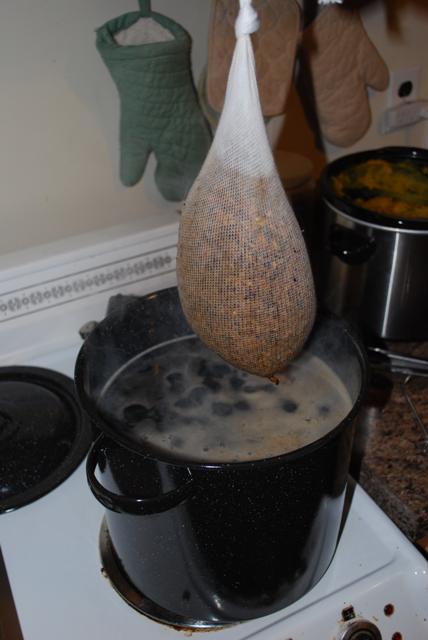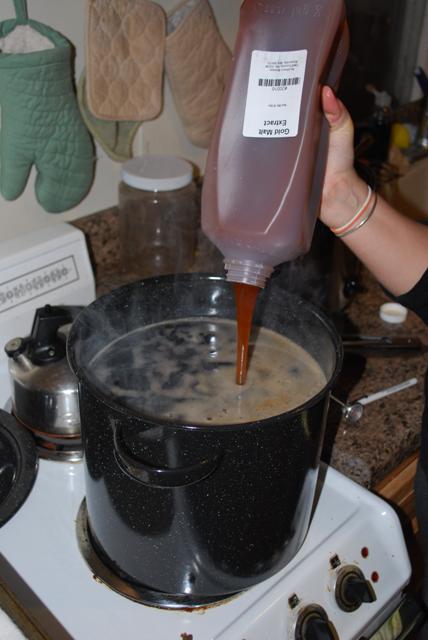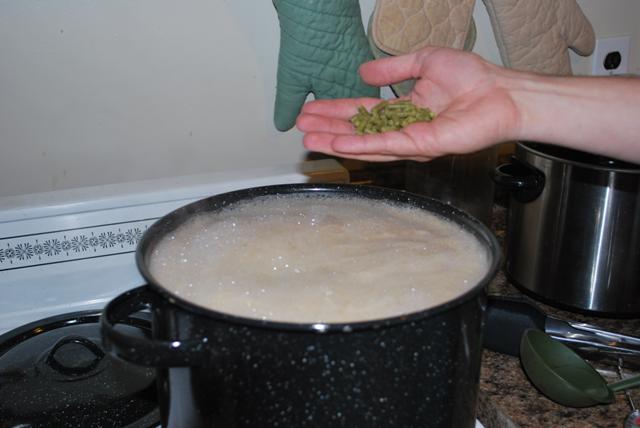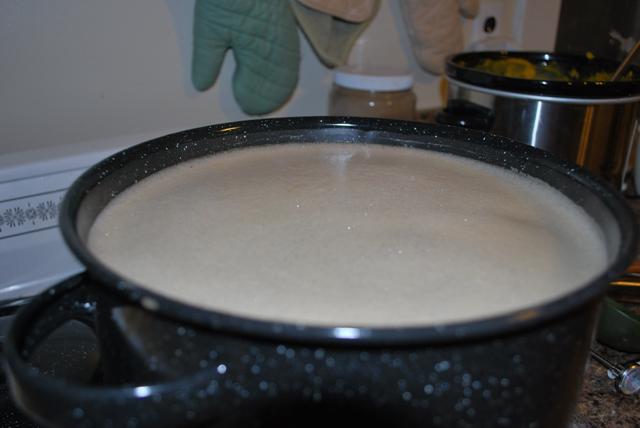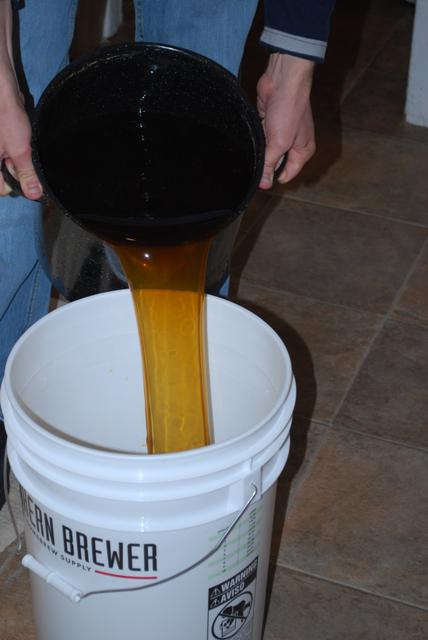
Step 1: Buy Some Beer

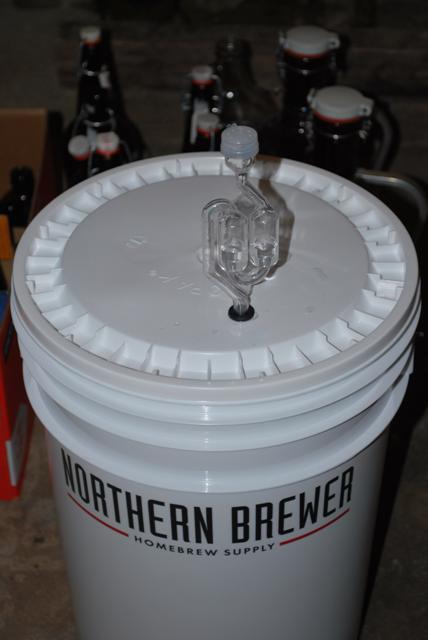
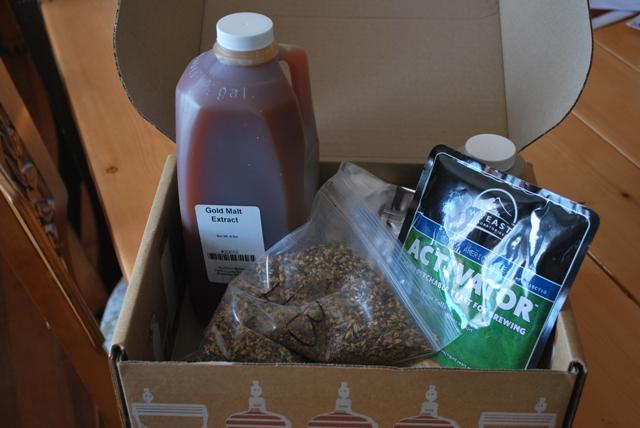
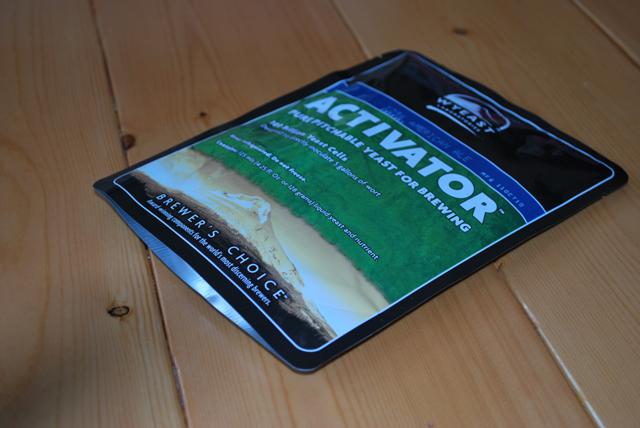
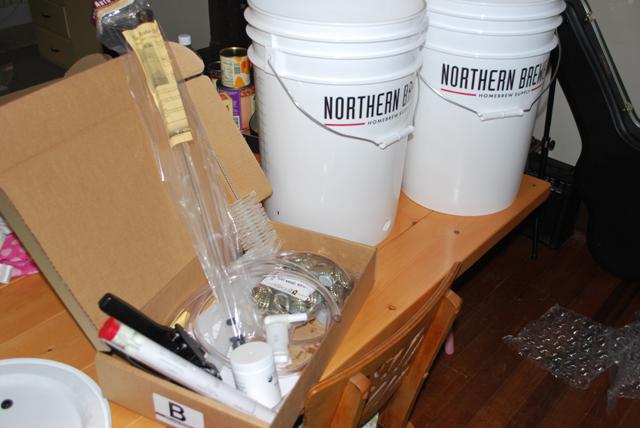
I woke up Saturday morning to find out I got my paycheck a few days early (!!!!), so I went ahead and got me a beer kit.  My boss, Dr. Doorn, had suggested a company that he’s gone through in the past called Northern Brewer, based out of Minnesota/Michigan.  He pointed out that they’ve got a pretty good variety of beers (he’s right…) and, perhaps most importantly, their close location means that shipping happens quite rapidly, so you don’t end up waiting for your package to arrive for a week or more as I would, perhaps, have to with William’s Brewing.  When comparing the two, it seems like their kits are very comparable in build and price, but Northern does seem to have a wider variety of beer options (94 options at the time of this writing), and you get to choose what kind of yeast you want (e.g. dry, liquid) and what kind of priming sugar.  Otherwise, everything else comes in each kit.

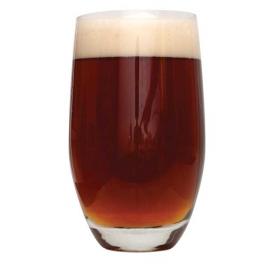
I got the cheaper set for now, as my Dad still has a few glass carboys from when he made wine a few years back.  If I decide to go that route, I can certainly do so, but for now, I’ll stick with my tried-and-true method.  For my first beer, I decided to go with a Honey Brown Ale (pictured above).  I went with that one for a few reasons, but one of them is that, compared with the other options, it should be ready relatively soon (close to 4 weeks).  Also, if you’ve never had one, a Honey Brown beer variety (assuming I do it right…) ends up being pretty smooth, not very bitter, and has a sweet flavor to it.  Therefore, hopefully, it’ll have a relatively wide appeal at Thanksgiving/Christmas gatherings this Fall/Winter.  For my next one, I’ll probably go with something more “hoppy,” which is the style of beer I tend to gravitate toward anymore.

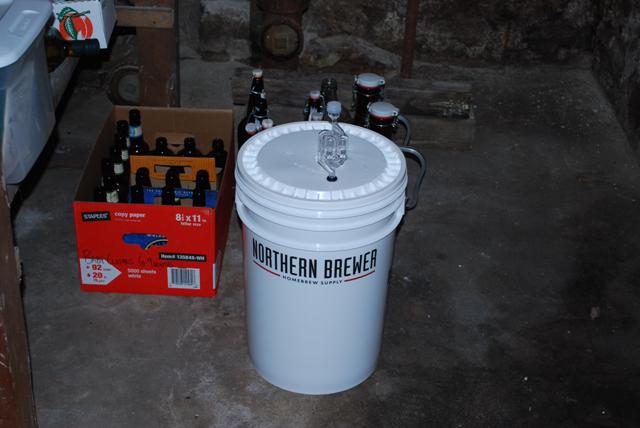
As the title of the post implies, I’ll be writing these in a series of “Steps” as I go through the process, and as such, I’m completing a few things right now before the beer is even here.  One is measuring the temperature in my intended brewing location: the unfinished, cellar-like basement of our house.  I’m recording the temperatures 3-4 times a day at varying times in hopes of getting an idea as to how stable the temperature will be.  The “cellar-like” part should hold stable, but that is where our furnace is and our washer/dryer, so I’m not sure how the “swings” will affect the brewing process.  Typically, you want your fermentation to occur in a relatively stable environment: not too cold, not too hot, but also not swinging wildly between extremes.  When I did did some brewing back in undergrad, we noticed that the yeast could be “shocked” into inactivity if the temperature dropped too far.  That meant the yeast, effectively, stopped doing what I wanted them to do: make alcohol and, consequently, beer.  So between last night and this morning, the temperature was hovering between 56 F and 60 F, and that’s fine by me.  Again, the yeast can handle temperatures in a variety of ranges, but they don’t like their temperatures being shifted around.  I could probably brew in the upper-40s to low-50s and be fine (with the right kind of yeast…), but the fermentation process would just be slower than it would in the upper-60s to low-70s.

Secondly, I’m collecting bottles.  Most beer kits come with a capper and bottle caps, the latter of which you can always purchase more of for relative cheapness.  We’ll slowly collect “interesting” 12 oz bottles, but basically we’re sticking with those that don’t have markings on the glass itself, like Sam Adams bottles or New Belgium bottles do.  We’ve got 24 of those, which should hold over 2 gal of beer.  I’ve also got two 2 L bottles, and nine 1 L bottles, all of which have reusable tops on them, so they don’t require capping.  Those should hold nearly 3 gal of beer, bringing me up to the 5 gal of total storage I will need.  I’ll probably try and keep a good mix like that, keeping most of the beer in the 1 L bottles, but making enough in the 12 oz bottles to either give away or take to gatherings in single-serving amounts.  We’ll probably collect more of those 12 oz bottles over time, but for now, we’ve got enough.

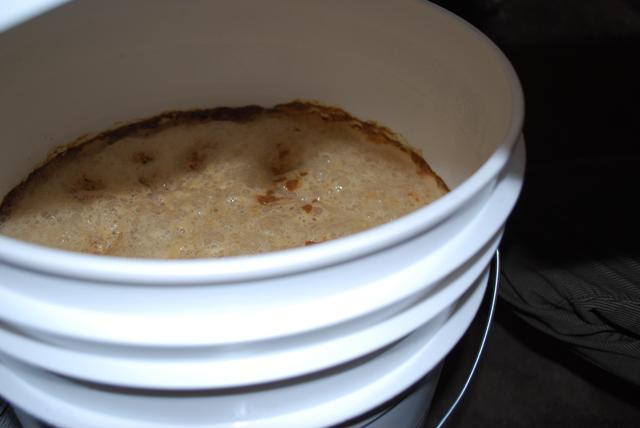
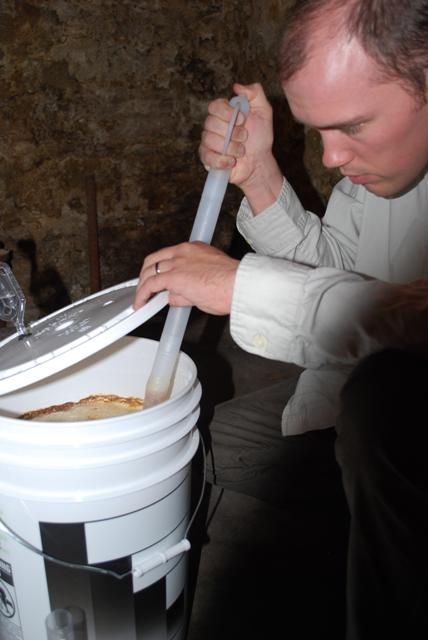
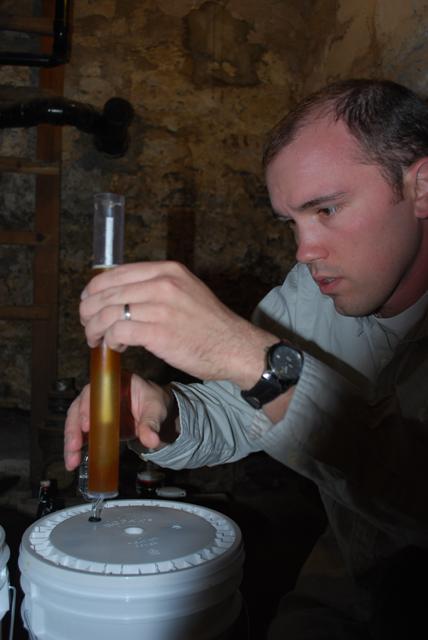
So hopefully the kit ships today or tomorrow and I’ll have it this week, and assuming all goes according to plan (which rarely happens, I realize…), I should have something quasi-drinkable by Thanksgiving.  The carbonation process will not have had much time around Thanksgiving, as that’s a bit over 3 weeks away), but this variety of beer shouldn’t require all that much carbonation, anyway.  It all depends on how the yeast do in the basement environment and whether they keep fermenting at a good pace.  We’ll see!

Primer: Memory

These posts, tagged “Primer,” are posted for two reasons: 1). to help me get better at teaching non-scientists about science-related topics; and 2). to help non-scientists learn more about things they otherwise would not. So, while I realize most people won’t read these, I’m going to write them anyway, partially for my own benefit, but mostly for yours.

The whole idea of “memory” has intrigued me for quite awhile, arguably before I was even that interested in science in general.  Part of this is my attraction to all things computers.  I think I build my first computer (rather, helped Dad build one…) back in the late-90s, and at that time, I began to understand all of the components that make it function.  The idea of “input/output,” the function of a central processing unit (CPU), RAM and hard drives…all of these things proved relatively easy to grasp, and in light of these general functions, it made my understanding of the brain a bit easier in the process.

Let’s think of it this way.  You interact with computers in different ways, but one way is with a keyboard.  You type something into the keyboard and the data you input is converted by the CPU into something that can be understood by the system, in this case, binary code (i.e. a series of “1s” and “0s”).  All of your inputs from the keyboard are stored in RAM for faster, short-term access.  If you click the “Save” button on whatever you’re doing, however, the data stored in RAM gets sent to the slower-access hard drive.  As you open programs, information is pulled off the hard drive and into RAM so that your CPU can process it faster, and then you and your keyboard can get at and interact with it.  This is why, in general, having more RAM speeds up your computer because it can pull larger and larger programs into RAM so your CPU can get at it easier, and thus, you can interact with it faster.

In very basic terms, your brain works the same way.  We have inputs in the form of our 5 senses.  The information from those senses gets encoded by your brain’s Cerebral Cortex and is stored temporarily in the Hippocampus (i.e. RAM) before being encoded for long-term storage back in other regions of the Cortex (i.e. hard drive).  Most of the time, your brain “Saves” it’s data to the Cortex at night, which is why sleeping is so very important.  The “processing” portion of this paradigm can be confusing, but keep in mind that the brain is divided up into specific regions.  There’s a “visual cortex,” an “auditory cortex,” etc.  These regions (within the Cortex…) interpret what each sense gives you and then sends that information through the Temporal and Parietal Lobes (also in the Cortex).  From there, the information is spread to the Hippocampus (i.e. RAM) for “integration” before being set as full, long-term memories out in the rest of the brain.

How is that information stored, you may ask?  Again, it’s much like a hard drive.  If you’ve used computers extensively, you know that hard drives are divided up into “sectors” (ever get a disc read error that says “bad sector?”).  When you have a new hard drive, you start with a clean slate.  As you install programs and add files, it gets filled up.  Once you delete something, that sector isn’t really “deleted,” but it is removed from your access: it isn’t really “deleted” until it’s overwritten by something else (which is why you can sometimes retrieve old files off a hard drive that you thought may have been deleted).  Whenever you “defragment” your hard drive, you are basically trying to rearrange those programs to keep everything closer together, and thus, quicker to access.  The data that’s encoded on the hard drive is done in “1s” and “0s” (i.e. binary code).  Each 1 or 0 is considered to be a “bit,” while a set of eight 1s and 0s (e.g. 11010101, 10011010, etc.) is considered a “byte.”  This is where “kilobytes,” “megabytes” and “gigabytes” come from.

The idea of 1s and 0s comes from logic, specifically the definitions of “True” (i.e. 1) and “False” (i.e. 0).  If you have a “1,” then you have a connection.  If you have a “0,” then you don’t.

Bringing this back to neuroscience, the same general rule appears to apply with regards to memories, or the concept of “learning” in general.  In order to form a memory, it needs to be encoded much like your hard drive is: in a series of combinations of connections (or missed connections) between neurons spanning the entire brain.  There are various molecular mechanisms that can account for these connections, or lack of connections, and those go back to receptor theory.  Remember that neurotransmission involves the release of a neurotransmitter (e.g. dopamine, adrenaline, etc.) from one neuron to bind with a receptor on another.  If a neuron stops receiving signals from another neuron, it will remove its receptors from the outside of the cell, thus limiting or negating the signal.  If, however, a neuron keeps getting increased signaling from an adjacent neuron, the subsequent neuron will increase the number of receptors on the outside of the cell, thus making it easier to signal.  Therefore, we have a mechanism for strengthening or weakening the connections between two neurons.

One could consider a “strengthened” neuronal connection to be a “1” and a “weakened” neuronal connection to be a “0.”  It is in this way, it is thought, that memories can be formed on a cell-to-cell basis.

These neurons that memories are stored in are located throughout the brain, similarly to “sectors” on your hard drive.  As you stop using certain memories, the synapses of those neurons weaken to the point where they can be, effectively, “overwritten” in favor of a new memory.  This is also how the idea of “repressed memories” can come about, in that you can have a memory stored in a region of your brain that you have forgotten about, but can re-manifest later: if it isn’t overwritten, it’s still there.

From a molecular standpoint, scientists have a pretty good idea how memory “works,” but being able to decode those memories is a whole different beast.  Returning to our computer metaphor, imagine knowing nothing about computers and finding a hard drive.  What would you do with it?  Would you take it apart?  How would you know what it was?  Or what it contained?  And once you figured out that it, somehow, contained information, how would you read it?  If you eventually found out that it involved 1s and 0s, how would you know how those 1s and 0s were organized across the hard drive, and then finally, what they told you?

This is why it’s highly unlikely that we’ll ever be able to make or see memories like we do in the movies, at least, not for a very long time.  It’s one thing to understand the basis for how it works, but it’s a whole other thing to try and figure out how it’s organized within a system like the human brain.  Also, it’s been estimated that the human brain contains terabytes of information, which translates to 8,000,000,000,000 to 8,000,000,000,000,000 individual 1s and 0s, or individual neuronal connections.

Imagine looking at a sheet (or multiple sheets…) of paper with that many 1s and 0s on it and trying to decide which version of Windows it represents.  Or where your dissertation is…not the Word Document, but the PDF.  That’s what we’re talking about.

So yeah, I just find the concept of memory to be fascinating.  With modern computers, we’re effectively reverse-engineering the human brain and, in doing so, learning more and more about how technological and biological computation can work.  But next time you see some “memory reading” device on TV, bear in mind what’s actually required to make that technology work.

Yay, beer!

Back at Truman, my roommate Andrew and I both majored in Chemistry and had found out that one of our professors made his own beer.  My Dad had dabbled in wine making a few years ago, so I was generally familiar with the process of making an alcoholic beverage, but Andrew had never done anything like that.  Of course, being future chemists (he’s getting his Ph.D. at UNC right now in their Chemistry department), he figured that we could give it a try and see what we got.  Of course, I was perfectly fine with this and we got started, with some pointers from our Chemistry professor.

We looked into a few options, but settled upon William’s Brewing for the kit we wanted.  Pictured above, the kit basically includes two 5 gallon buckets for fermentation and priming of your beer, tubing, a gravimeter (for detecting the alcohol content), bottle caps + bottle capper, and some instructions to get you started.  The company also sells a variety of beers, although once you have the equipment, you can make beer any way you want from whatever company you want, or just get all the ingredients yourself.  William’s Brewing makes it pretty easy giving you the components you need in a single box (e.g. malt, hops, sugar, yeast), and have the yeast/hops matched for the variety that they are getting you (i.e. pale ale, wheat beer, etc.).

When we left Kirksville, Chambers and I sold our kit to another Chemistry student, but I always intended on getting back into it.  Chambers continued on at UNC and has made a few varieties since, and told me the turned out quite well.  In St. Louis, however, I never really had a good location for brewing.  Besides keeping your equipment sterile during the brewing process, the other really big thing you have to consider is the temperature of your brewing, and keeping it consistent.  Yeast tend to like a consistent environment when they ferment your malt and make alcohol, so allowing huge swings in temperature will “shock” them into either a hibernation-like state, or death – neither of which are particularly helpful when making beer.  In Kirksville, we did this by fermenting in a closet that was generally insulated from changes in A/C or heating in the winter time, only varying the temperature by about 5 F.  In St. Louis, at our first apartment, we didn’t really have the space for it, and in Soulard, the temperature swings were still generally difficult to manage.

Now that we’re in Iowa and we’ve got quite a bit more space, I think I’m ready to get back into it.  I think Brooke’s even on-board with helping me out from time to time, so long as she gets some of the beer, of course.  Once I actually get this going, I’ll post about what the full process is, but I’ll go ahead and mention right here that we should get around 5 gal of beer per batch, and each batch takes around 2-3 weeks from start to drink-ability.  5 gal translates to 40 pts, so if you figure that the average cost of a kit from William’s Brewing is around $36.90 (depending on which kit you get, of course), it ends up getting you 40 beers at about $1 each.  Not a bad deal, methinks.

My goal is to get one of these things purchased in early November and, if all goes well, have a batch ready by Thanksgiving.  I can’t guarantee that batch will be good, but I’ll certainly drink it.  It may take a few tries before I figure out the best placement of the fermentation bucket, the styles that work best with our water (we are using well water, but I’ll used the filtered stuff for this…I don’t like the taste of sulfur in my beer, and I don’t think the yeast will like it much, either), and the logistics of actually making the beer in our small kitchen (more on that when I describe the process…).  So yeah, hopefully a good trial run by Thanksgiving, and maybe my first truly spectacular batch by Christmas.  If all goes according to plan…

Are You Afraid Of The Dark?

Scary movies are something I’ve come to enjoy relatively late compared with others.  Many (most?) of the modern horror movies are rated “R,” and thus, I wasn’t really allowed to see any of them until late-high school.  Therefore, I’ve probably seen more “scary thrillers” (e.g. “Se7en“) than I’ve seen “horror” (e.g. “A Nightmare on Elm Street“) movies.  I did, however, make it a point to see many of the “classics” of the 30s and 40s, including “Frankenstein,” “Dracula,” “The Wolf Man,” etc.  Alternatively, Brooke had something of a problem with nightmares when growing up, so her Mom (amusingly…) subjected her to quite a few in a (failed) effort to desensitize her.  While I’ve seen many of the oldies, Brooke saw more of the 70s and 80s classics.

Since we got married, though, we’ve tried watching more scary movies when October rolls around.  We do our best to watch “Hocus Pocus” every year if possible, but since we don’t have cable (and, therefore, don’t have ABC Family…which shows it every year without fail…), we may not get to see it unless we get that far in our Netflix Queue.  This year, I decided to put a few of them up here that we will be watching in the coming weeks.

We watched this one Saturday night. Quite honestly, I’ve never found “The Exorcist” to be all that appealing, and certainly not scary. I know people have said in the past that part of the “scariness” is that “it actually happened”…which it kinda didn’t, but whatever… Regardless, I’d seen it before and Brooke hadn’t, and I noticed awhile back that it was on Netflix streaming so we added it to the queue. Once we hit October, it was time to start watching scary movies. After finishing it, I wanted to play some games, but Brooke said we had to watch an episode of “30 Rock” so she’d be able to sleep… 😛

I’ve never seen the original “Night of the Living Dead,” but it’s on Netflix Streaming, so now’s the time. Brooke wanted to watch it last year, as it was one of those her Mom made her watch years ago, so I went out of my way to “find a copy” (cough…), however when I started showing the movie to her, she said “this isn’t ‘Night of the Living Dead’!” After going to great lengths to prove to her that this was the movie she had instructed me to find, she then decided that, apparently, her Mom made her watch “some other zombie” movie and she, in fact, had never seen it. Therefore, we’re going to watch it for realz this time.

Scream” is one of the first “modern horror” movies I saw and set off a trend of newer slasher movies in the mid-to-late 90s. I saw all three of them (a fourth’s on the way) and, by far, the first one is the best. Brooke’s never seen it but I think she’ll enjoy it. It’ll probably scare her a bit, though. 🙂

Poltergeist” is another one that I never got around to seeing, but Brooke remembers vividly from growing up. Brooke actually bought it on sale last October but we never got around to watching it. I guess this year’s the time.

I would bet that most people haven’t heard of “Abbott and Costello Meet Frankenstein,” but it’s one of my “old school” favorites. It certainly isn’t scary, but it does involve the Wolf Man, Frankenstein’s monster, and Dracula. Lon Chaney, Jr. and Bela Legosi were both in it, but unfortunately Boris Karloff wasn’t playing the Monster. Regardless, it’s one of my old favorites and it’s up on Netflix Streaming. I’m sure Brooke will love it. And won’t be scared. 🙂

I’m going to go ahead and add this one to the list, although Brooke probably doesn’t realize that we’ll be watching this one, too.  This is probably my favorite “horror movie” for a variety of reasons.  For one thing, it does an excellent job keeping you in suspense for the majority of the movie, where you don’t necessarily who’s going to go at any given time (in most modern ones, you can see it coming a mile away, at least in the mainstream flicks).  Also, the movie involved no blood – you saw all kinds of deaths, but they weren’t particularly “gory.”  Of course, the movies that followed in the series all got progressively worse in that regard, but this one did a good job of making do with very little in the way of special effects.  The original “Halloween” is the movie that spawned the “Friday the 13ths” and “Nightmares on Elm Street” that would follow in the 80s, so in many ways, most modern horror movies have to pay homage to this first one.

Oh yeah, and the mask Michael Meyers wears is a William Shatner mask painted white.  How cool is that?!

A few “runners up” that we may or may not get to during the course of the month.  “Alien” is a classic that we own, but Brooke probably won’t watch with me.  We’ve got “Evil Dead” and “Evil Dead 2” – I need to keep my eye out for a good copy of “Army of Darkness” in order to complete the set.  “I Know What You Did Last Summer” is one I’ve never seen, but is available on Netflix Streaming.  Finally, I’ve added the new Rob Zombie remakes of “Halloween” and “Halloween II” to our DVD queue, as I’ve never seen them and the original is one of my all time favorites.  I may be watching all of these last ones alone.  And I’ll love them all.  🙂

Primer: The Scientific Method

These posts, tagged “Primer,” are posted for two reasons: 1). to help me get better at teaching non-scientists about science-related topics; and 2). to help non-scientists learn more about things they otherwise would not. So, while I realize most people won’t read these, I’m going to write them anyway, partially for my own benefit, but mostly for yours.

There are quite a few things that go flying by in the news that concern me (and I have posted about them here…at…length…), but one that really gets to me is public misunderstanding of Science.  As in, capital “S” Science.  Not really the fact that many people don’t know certain scientific facts, or don’t really understand how many things work, but more that they do not understand how science is done and what it really means.  I will seek to clear up some of that here.

First, however, what does Dictionary.com tell us?

Science – noun

1. a branch of knowledge or study dealing with a body of facts or truths systematically arranged and showing the operation of general laws: the mathematical sciences.
2. systematic knowledge of the physical or material world gained through observation and experimentation.
3. any of the branches of natural or physical science.
4. systematized knowledge in general.
5. knowledge, as of facts or principles; knowledge gained by systematic study.

Now, this definition seems to center upon the natural/physical sciences, however many, if not all, of the principles that “science” adheres to apply to the social sciences (e.g. sociology, psychology, etc.) and to many other degrees.  However, I will focus on what I know best.

“Systematically” is the word sprinkled about in the definition above, and rightfully so.  “Systematically” refers to how science is conducted, generally through what we refer to as the scientific method.  The Wikipedia article, as usual, is a good start for further information on this particular subject, but basically, here’s how it works:

  1. Formulate a hypothesis
  2. Test the hypothesis through experimentation and observation
  3. Use collected data to confirm or refute the initial hypothesis
  4. Form a new hypothesis based on what was learned in steps 1-3

A “hypothesis,” put simply, is an educated guess toward a question you have.  Many times, especially when you’re first learning the scientific method, you may phrase it in the form of an “If/Then” statement.  For example:

If I drop this rock, then it will fall

The “If” portion of the above statement represents the “Independent Variable,” while the “Then” portion represents the “Dependent Variable.”  Effectively, the Dependent Variable is what you’re measuring and the Independent Variable is what you’re changing in the system.  In this particular case, if you drop the rock, does it fall or not?  You can measure whether or not it falls.  If you don’t drop the rock, does it still fall?  And so on.  It is called the Dependent Variable because it “depends” on what you do in the Independent Variable.

You are generally allowed to have multiple Independent Variables in a given hypothesis (or series of hypotheses), but the Dependent Variable cannot change. What would happen if I dropped a rock on Earth and dropped another one on Mercury?  My results wouldn’t be comparable, because I changed too many things.  I could change the size of the rock, but if I’m measuring the rate at which the rock falls to the ground, I need to make sure the force of gravity is held constant.

Obviously, this is a very simple example.  If one were to ask something a bit more complicated, you could ask the following:

If Tylenol is administered to people with headaches, then they will experience pain relief.

The question above seems simple enough, right?  I could just give Tylenol to a bunch of people with headaches and see if we get an effect.  Then I would know if my hypothesis was correct or if it wasn’t.  But what would happen if I grabbed people prone to migraine headaches were participating in my study?  Or alcoholics (that don’t break down Tylenol all that well)?  The data I would receive would be flawed, as the Tylenol probably wouldn’t do anything to people with migraines and it may actually make alcoholics feel worse.  My hypothesis would be proven wrong.

Here is where we really need to consider “Controls.”  These are a separate series of experiments that you use to compare your experimental results to.  You may choose to set this up in your experiment in a variety of ways, but one possibility is to give those with migraines or the alcoholics (and all other test subjects) a “placebo,” or something that looks like Tylenol, but is actually inert.  Then, you can compare your responses to see if Tylenol had any effect or not.

Above, I mention that after you formulate a hypothesis, you must test it.  You must test it by holding as many things constant as you can while only varying a specific aspect of the experiment, especially an aspect that you can control to some degree.  This brings us to the idea of “testability.”  In order for your experiment to be considered “Scientific,” it must be testable.  If it isn’t “testable,” then it doesn’t satisfy the “systematic” part of the definition.

Over time, enough experiments are done to warrant considering a certain concept to be a “Scientific Theory.”  That is to say, a Theory is an idea that is supported by an array of evidence and co-exists with other known Theories that are equally verified by experimentation.  Assuming a Theory stands the test of time, it eventually is considered to be a “Scientific Law,” meaning it represents something truly fundamental on which the rest of science and knowledge rests.  An example of a Theory is “The Theory of Natural Selection.”  An example of a Law is “Newton’s Laws of Thermodynamics.”  Wikipedia also has a nice list of other Scientific Laws.

Most Laws tend to be Physics/Chemistry-related, as these are the bedrock concepts upon which everything else stands.  You can’t really study Biology without fluid dynamics and quantum mechanics (well, you can ignore them for the most part, but they do get involved in certain situations).  Theories, on the other hand, are much less clear cut.  They tend to represent a constantly evolving field of research, where new data is being applied every day.  I will steal the US National Academy of Sciences definition to explain more fully:

Some scientific explanations are so well established that no new evidence is likely to alter them. The explanation becomes a scientific theory. In everyday language a theory means a hunch or speculation. Not so in science. In science, the word theory refers to a comprehensive explanation of an important feature of nature supported by facts gathered over time. Theories also allow scientists to make predictions about as yet unobserved phenomena.

A scientific theory is a well-substantiated explanation of some aspect of the natural world, based on a body of facts that have been repeatedly confirmed through observation and experiment. Such fact-supported theories are not “guesses” but reliable accounts of the real world. The theory of biological evolution is more than “just a theory.” It is as factual an explanation of the universe as the atomic theory of matter or the germ theory of disease. Our understanding of gravity is still a work in progress. But the phenomenon of gravity, like evolution, is an accepted fact.

So in some ways, a Theory is treated on almost the same plane as a Law, but they really aren’t the same thing. A Theory can still be modified, while a Law is much, much harder to change.  In that first sentence, it says “no new evidence is likely to alter,” meaning you could still alter it, but it’s highly unlikely.

My overall concern with perceptions of what Science is stem from the various debates over climate change, evolution, stem cell research, etc.  In many ways, much of the political hubbub is regarding something that Science isn’t equipped to answer.  By definition, it can only give you a fact – it is up to the individual to decide how to apply their morals to that fact.  Science can tell you that Evolution is happening and that Natural Selection is the current Theory to describe how it happens.  It’s a “Theory” because more data is getting added every day, but the Theory is only strengthened, not weakened.  Overall, Natural Selection is what happens.  End of story.  Scientifically, embryonic stem cells come from an embryo, which is a collection of cells that does not fit the accepted definition of “alive” (i.e. self-awareness, self-preservation, consciousness).  Whether or not you agree that an embryo is not alive is up to you to decide, but arbitrarily suggesting that “Science says that it’s a life” is incorrect and a misuse of the term.  Saying that there are “gaps in the geological record,” so that must mean that God exists and God created the Earth in 6 days, ignores how Science works – God is, by nature, “untestable,” and therefore beyond the purview of Scientific understanding.  These are but a few of the examples of how some would misunderstand Science and try to apply it to things that it shouldn’t be applied to, or at least in ways it shouldn’t be applied.

The Study of Science is a systematic, logical progression that involves the formulation of a testable hypothesis, where testing involves experimentation, observation and collection of data to support or refute the hypothesis.  Hypotheses around a general subject can eventually add up to a Theory, and truly fundamental observations of the natural world become Law.  That’s all it is, folks.  No more.  No less.

New Developments

In recent weeks, Meg has gotten quite a bit better about sitting up.  This, I’m told, is typical of most babies in their 6th month of life, so I guess it shouldn’t be all that surprising.  The crazy thing is just how quickly she seems to be developing!  Within the past few weeks, she has started getting much more “tactile” in her interactions.  She still doesn’t quite understand that her hands are, necessarily, “controllable” by her brain, but she has realized she has them and that she can pick things up with them.

"What can I do with this?"

The most interesting part to me, however, is how she has started to grab my face and grab Edie.  She takes such an interest in touching my face, almost as if she didn’t quite realize that I was alive, or that I was “real,” for the past few months.  As if she now has a different sense of me, or of people in general.  Maybe as if she treated all the people around her much like people on a TV screen: they’re there, but they aren’t really “there,” if that makes any sense.

Meg has always paid close attention to Edie, watching her walk through the house and so on, but now she can actually reach out and touch her.  Thankfully, Edie is just fine with this.  Meg reaches out and will hold onto Edie’s skin (more than the hair).  Meg just stares at Edie, possibly wondering if she’ll move or run off.

"I'm very proud of all my toys!"

Regardless, it’s been fun over the past few weeks watching her.  It’s just cool to watch someone learn things for the first time, things that we adults tend to take for granted.  Not even relatively simple things like “walking” or “sitting,” but just the realization that people exist and that you can actually interact with them, rather than watch them.

One Decade Down

This coming weekend marks my 10 year Hickman High School reunion – The Class of 2000.  It took me awhile to find the Columbia Daily Tribune’s article about it (way back in their “archives”…that aren’t what I’d call “searchable”), mostly so I could remind myself of the statistics these kinds of things tend to include: 619 graduates, 73% of which were going on to four-year colleges, 13% to jobs, and the remainder to two-year schools or the military.

We’ll be heading down to Columbia this Friday to attend this year’s Hickman Homecoming Game, and hopefully we’ll get to see my old marching band play some of this year’s show while we’re at it.  Otherwise, the general “plan” is for people to get together for some Mizzou tailgating (which I won’t do, in favor of frolfing with Stu…) followed by a group dinner at Boone Tavern on Saturday night.  RSVPs for all of this were done over Facebook, so while I have some idea who is attending, I don’t know exactly because the invites were only sent to “fans” of “Hickman High School Class of 2000.”  If you weren’t a “fan” of that particular Facebook Group, you probably didn’t get the invite.  So yeah, to an extent, I have no idea who’s going to even be at this event, besides a few specific people I’ve chit-chatted with in the past few months.

That all aside, we’re due for a visit to Columbia.  We haven’t been down there for a few months now and Mom is itching to take Meg shopping for some winter clothes (which is good, ’cause Iowa is COLD).

But back to the Reunion.  This will be the first time most of my “Group of Friends” from high school meet Meg.  In a few cases, this will be the first time they meet Brooke!  I guess part of the fun of going to a 10 year High School Reunion is “reconnecting” with friends you haven’t seen in years (or a decade), but it’s going to be fascinating to see what trajectories we all ended up on.  I was friends with a wide variety of folks in high school, ranging from valedictorians to band geeks to space station simulators.  To date, I’m the only one I can think of from high school that was part of that group and also has a child.  I’m also one of the few that is married (although most have “significant others,” to some degree).  Considering 10 years has passed, I find those particular milestones to be rather interesting, as I’d argue that the preceding generations had a higher percentage of individuals that were married and had at least one kid 10 years after graduating high school (my Mom had 2 kids within 10 years of graduation).

I guess  I’m just reflecting on how I ended up here, as compared with others from my graduating class.  Whether it was always subconsciously in the plan to be married, have kids, and have a Ph.D. in time for my 10 year reunion.  Whether that notion was part of other people’s plans, or whether their lives took them in completely different directions than they’d otherwise intended.  Whether I will be considered the odd-man-out, or whether someone else’s shocking revelation will trounce anything I could come up with in this post.

Don’t get me wrong: I’m not worried about going to the reunion.  On TV, you see people fretting about going back to their high school reunions, usually that they’ll seem somehow “less successful” than their brethren, or that they have memories of the “high school experience” that no one else remembers like you do (think of the season three 30 Rock episode, “Reunion“).  Despite my questions above, I’m just genuinely intrigued by the idea of how my experience differs from the experiences of the other people I hung out with in high school.  Personally, I think if we were to rate attendees based on their “successes” post-graduation, I’d rate fairly highly.  I guess I’m just wondering if I meet the expectations that my friends had 10 years ago, and if they will all meet mine.

I guess I just find it all to be “curious.”

God is (Un)necessary

I listened to an episode of On Point on NPR this past weekend, where Tom Ashbrook interviewed Leonard Mlodinow, co-author with Stephen Hawking of a new book titled “The Grand Design.”  I had never heard of Mlodinow before this episode, but I’d certainly heard of Hawking, the theoretical physicist that is confined to his wheelchair as a result of advanced ALS who wrote “A Brief History of Time” back in the 80s.  His first book, “A Brief History…” was relatively short (heck, even I was able to read it) and did a reasonably good job at helping explain to the layman some very advanced cosmological concepts.

Their new book, “The Grand Design,” is set up to answer the question: “Is God necessary?”  Or more generally, does all life in the Universe require the hand of an all-powerful Creator being?  According to their book, the answer is “no.”

Now, as Mlodinow says in the interview, that answer doesn’t mean “there is no God.”  He points this out a few times: Science itself cannot determine whether or not God (or any Creator) exists, but many or all of the questions of Creation can, in fact, be explained by Science.  Hawking was quoted when the book came out as saying that “there is no God,” but that was a mischaracterization of what the book describes.

Interestingly, around the 12:30 mark of the podcast, Ashbrook plays some tape of an interview with Hawking from a few years ago.

Interviewer: “Do you believe in God?”

Hawking: “The basic assumption of science is scientific determinism. The laws of science determine the evolution of the universe, given its state at one time. These laws may, or may not, have been decreed by God, but he cannot intervene to break the laws, or they would not be laws. That leaves God with the freedom to choose the initial state of the universe, but even here, it seems, there may be laws. So God would have no freedom at all.”

While I realize this is something of a cryptic answer, my interpretation is that Hawking kinda believes as I do about this whole “Creation” thing.  Hawking is describing the idea that our Universe is based on a series of Laws (e.g. gravity, the speed of light, etc.) and our Universe is well-suited to the existence of Life (as we know it…).  If the Universe did not have the Laws it currently does, then Life would not exist (as we know it).  Therefore, God set a series of Laws (or adhered to previously existing ones) that allowed for the existence of Life.  Therefore, we humans eventually showed up on the cosmic block.

So yeah, as the authors point out, a Creator may not be “necessary” in a Scientific manner, in that our Universe is apparently set up in such a fashion that Life can and does exist.  From that standpoint, God is “unnecessary.”

However, I would argue that God is, in fact, “necessary” for our lives, at the very least for the social and moral implications.  Sure, God may not be “necessary” for our existence, but He is “necessary” for bringing meaning to that existence.  For providing a moral compass to follow.  For helping define who we are and who we all want to be.  It all depends on how one views “God” (whether in the Christian, Muslim, or Judaic traditions, amongst others), but all faith traditions provide us with a relatively clear idea of the kind of people we should be.  The kind of people we all want to be.

I guess I’ve always felt this way.  I’ve never felt that the “Creation” part of the Bible was all that important to who I was.  The Book of Genesis does not define my life.  It really isn’t important how I was “created.”  However, it’s important that I’m here now.  I do exist, regardless of how it happened.  My existence entails a sense of responsibility that I conduct that existence in a manner I can be proud of.  So for me, God is necessary.

Side-note: Tom Ashbrook asks Mlodinow multiple times to explain how you get “something” out of “nothing,” as in, how exactly did all of the things we know just “spring up” out of the void of existence (e.g. the initial “Creation” itself).  He tries explaining a few times but it was still pretty difficult to follow…may just need to read the book…  I think he was trying to explain it in terms of quantum mechanics in that, according to what we know from quantum theory, you can actually have things just “appear.”  He never said “Heisenberg’s Uncertainty Principle,” but I think that’s what he was getting at.  Heisenberg stated that you can either know where an object is in space or how fast it’s moving, but you can’t know both at the same time.  As I understand the theory, there’s all kinds of math involved that suggests you can actually get “something” out of “nothing.”  Mlodinow also talked about multiple dimensions in his answer.  In short, I don’t really understand it either, but it was addressed in the podcast as well…. 😛

It’s getting colder!!

So, our good friend Carol made us a few things to help us survive the frigid Iowa winters: car scrapers with wool sleeves to keep your hands cold!  She knows all too well how cold it can get up north in the Norse country.

Regardless, thanks Carol!  We (obviously) appreciate them and look forward to using them…likely…daily…  🙂

We ended up having to use the A/C a bit last week, but thankfully the temps have dropped to more reasonable levels.  The lows this week are in the 40 F to 50 F range, so we won’t be needing it anymore, we hope.  Honestly, I’m ready to unpack some long-sleeved items and move into the Fall, though I’d rather delay the snowfall until closer to never.  Granted, in moving to Iowa, we knew that snow would end up being a bigger deal than it ever was in St. Louis (or the entirety of Missouri, for that matter), but it would be nice to get an extended period of “Fall” this year rather than jump directly into Winter.

Either way, I think we’re both ready to go with some cooler weather.  We just hope it holds at “cooler” rather than “freezing” for a month or two.  At least we’ve got some nice, warm, window scrapers to tide us by!

Teaching Experience

About a month ago, the FUTURE in Biomedical Sciences group here at the University held a forum, of sorts, to help answer questions from graduate students and postdocs regarding what it takes to get a job at a Liberal Arts institution, especially in the State of Iowa (where these four individuals reside).  The FUTURE group, now in its second year, has multiple professors from Liberal Arts schools across the state (this year’s participants came from Loras College, Drake University, Morningside College and Wartburg College) come to Iowa City to do research for the summer, learning some new experimental techniques and generally expanding their horizons beyond what they can do at their respective institutions.  The forum was very informative, covering a variety of topics including how to write up your resume, what kinds of places to apply to, what to look for in a school, when to start looking for jobs, and what the jobs tend to be like.  More than anything, however, they all stressed the need for experience: the more experience you have on your application, the better chance you’ll stand against other applicants.  I’m not really looking for another job yet or anything, but it’s really good to have this information at the back of my mind as I keep building up that resume.  Hearing them talk about their jobs makes me want to get to that stage even more, providing me with some much needed motivation to get a few things done while I’m here!

Thankfully, I already have a leg up on that one.  Back at SLU, I had the good fortune of getting to teach in “Drugs We Use and Abuse,” a course run by the graduate students of the Pharm/Phys Department.  It is team-taught each Fall to around 50 non-majors (e.g. Business majors, History majors, etc.) and generally centers around…well…just what it sounds like.  If you ever wanted to learn what meth, cocaine, opiates, depressants and caffeine do to your body, then this is the class for you.  I taught in it for 3 years: I was a section director for 2 of those years and course director for 1 year.  The experience was very good, so much that I decided I want to do it full-time as a career: teach at the undergraduate level.

When I took the position here at the University of Iowa, I asked my mentor if it would be alright for me to continue teaching occasionally alongside the rest of the research I’m doing.  He was kind enough to allow it (if anything, he was excited that I’d take a few lectures off his hands).  This October, I’ll be teaching two classes of Advanced Toxicology, one talking about neurotransmission and the other talking about neurotoxic agents (e.g. cocaine, methamphetamine and ecstasy).  Both of these subjects are within my proverbial wheelhouse, so they shouldn’t take up all that much preparation time.  That, and I have the previous year’s lectures in a Powerpoint file to help me throw something together.  While Drugs We Use and Abuse was directed at non-major undergraduates, this class is for graduate students and there are only 12 in the class, so the dynamic will be quite a bit different than what I’m used to.

I will likely get the opportunity to teach in the Spring as well.  That course is in our department, Medicinal Chemistry and Natural Products, and is also targeted at graduate students (and will likely be just as small, if not smaller).  Not sure when we’ll get that going, but it probably won’t be until January, knowing how things go around here.

Either way, I think I’m doing a reasonably decent job at preparing for what’s ahead, with regards to that whole “career” thing.  At the very least, getting to add a few “guest lecturer” points on my CV is always a welcome addition.

And maybe I’ll even have a little fun doing it.  🙂