
Tough Choice

There have been various announcements over the past few months that got me excited about both options.  They both have some great benefits and the implementations are very functional, if not even downright awesome.  To some degree, it isn’t really a “tough choice” at all, as I already know which option I’m going to go with.

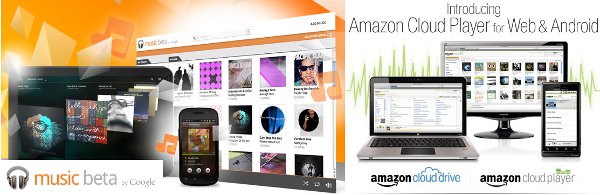
Of course, I’m talking about Google Music vs Amazon Cloud Player.

To be fair, as of this writing, I haven’t actually tried the Google Music Beta, though I signed up for an invite as soon as I found out that this thing exists at all.  I’ve been using the Amazon Cloud Player, though, and like it quite a bit.

I guess I should describe the pros and cons.  The Amazon Cloud Player was launched in late March, providing users with 5 GB of free storage space for their files.  MP3s, documents, pictures, videos, etc.  Any MP3s stored on this virtual drive, however, can be streamed over the internet through your web browser or smart phone (i.e. Android and iOS),  through what they call the Cloud Player.  If you buy any digital album from Amazon MP3, then your 5 GB of storage is increased to 20 GB – you can purchase additional space thereafter.  The service has worked well, from my perspective, and it’s nice to be able to pull up any of my albums and play them from practically anywhere, especially as I’m not carrying my laptop around with me 24/7 like I used to.

Amazon kinda shocked the world when they released this, however.  It was long expected that Apple or Google would go there first, but they were dealing with the legal rights to stream music over the internet.  The question, from a legal standpoint, is whether it is legal to purchase music, upload it to a different location, and then stream it like a radio station.  Does that violate the license that you agree to when you purchase an MP3?  No clear answer was given, so Google and Apple were trying to get things finalized before going ahead with their respective plans.

Amazon basically just said “oh well” and did it anyway.  And so far, to my knowledge, no one has sued them.

Therefore, it was expected that Google would make an announcement during their now annual I/O developer’s conference.  And as expected, Google announced their long-awaited solution: Google Music.  Since Amazon took the lead, they had to come forward with something to show their burgeoning community.  And show they did.

The Google Music Beta, rolling out piecemeal by invitation only (much like Gmail did), allows you to upload 20,000 songs to their cloud service, and then you can stream it to your Android devices or the web.  In that way, it’s very similar to the Amazon Cloud Player.  The catch is that Google Music should be capable of providing better sound quality, even over a relatively slow 3G wireless connection.  Right now, however, you cannot actually purchase music through the Google Music interface like you can from the Amazon system.  Therefore, for digital music, you still need Amazon MP3 or iTunes.

The kicker for me, however, is offline play.

With Google Music, you can “pin” a song, album, or playlist that will synchronize that music on your various devices.  It will automatically synchronize your “recently played” music, as well.  So, for example, if I want to “pin” Under The Table And Dreaming (and I will…), Google Music will download the album to my phone, allowing me to play that music even when my phone isn’t on an internet connection.  And this is extremely important for people like us that don’t have unlimited data plans, or that tend to drive long distances through areas that don’t have the best cellular coverage.  I can rely on streaming, but I don’t have to.

With a single, software-based approach, Google provided me with a good reason to abandon my iPod Nano.

Don’t get me wrong.  I love my iPod.  The thing is light, gets good battery life, and is tiny.  Or “nano,” if you will.  But, I have to physically connect it to my laptop to transfer podcasts and music.  This isn’t that huge of a deal breaker for me, to tell you the truth, but I’ve got its cute little 8 GB hard drive maxed out, so I’m constantly selecting which podcasts need to go on the hard drive and when.  And sometimes, new editions of my podcasts are released while I’m at work, preventing me from being able to actually add them to my iPod, because my iPod is only linked with my laptop.

Now, using my phone, I can stream all of my music (~15 GB?) over the internet, and save the ones I want on my phone’s mini-SD card.  Moreover, as my phone has WiFi on it and a wealth of apps, I can access most if not all of those podcasts without having to download them to whatever device I’m using.

So in the end, I think I’ll be using the Google Music offering.  At least, once I get an invite.  For the time-being, I’ll settle for the Amazon Cloud Player.  It’ll be interesting to see what Amazon does to compete here, as Apple will be announcing their own “iCloud” service sometime in the relatively near future, and if Amazon wants to compete, they’ll have to do some drastic things.  iCloud will be built into every iOS device, and Google Music will be built into every Android device.  And the legal drama certainly isn’t over, as the record labels are unhappy with Google’s plan, and likely won’t be all that happy with Apple’s, either.

Where does Amazon go?

And the Oscar goes to…

Brooke has a friend that’s slowly making their way through all the “Best Picture” winners via Netflix, so we figured that, as we aren’t really devoted to a single show right now in our Netflix Queue, we can probably start heading that way, too.  We’ve seen quite a few of the more recent ones, so I’ll just highlight the ones below that we’re going to try and watch.  Movies that aren’t highlighted are those that either we’ve both seen, or one of us has seen and can’t convince the other to watch it (I’m looking at you, “Return of the King” and “Titanic“).

This will take practically forever to accomplish, but I figured it was worth posting.  We’re only going back to the year of my birth, at this point.  Once we get that far, then we’ll re-evaluate whether we want to go further.

Academy Award “Best Picture” Winners

Roddenberrian Economics

Ayn Rand is someone I’ve heard of in the past, but up until now, haven’t really paid much attention to.  I “got into it” with someone over Facebook a few weeks ago regarding “Randian disciples” and learned a bit more about her in the process.  Then, at the end of April, NPR’s On Point had a discussion about her, specifically with reference to the Tea Party.  The architect of the Republican Congress’ budget plan, Paul Ryan, has referenced her on multiple occasions.  There is also a movie out, “Atlas Shrugged: Part I,” which was released in a partial attempt to capitalize on her resurgence, though Rotten Tomatoes currently has the film sitting at around 9% positive ratings.

Rand grew up in Russia and moved to the United States in 1926.  She was a philosopher and writer, and is perhaps best known for her books, “The Fountainhead” and “Atlas Shrugged,” both products of the mid-20th Century.  Due in part to her upbringing and the general climate in the post-World War II world, she embraced the concepts of Objectivism and was very much a rational individualist.  She opposed in Collectivism, an idea that contributes to Socialism and Communism.  Because of her beliefs, and the stories she told in her books, fiscal Conservatives, and especially Libertarians, have embraced her and in some ways treat her as a figurehead for their ideas.  Alan Greenspan was one of the founding members of Rand’s ironically named “Collective,” a group of close confidants and proponents of Objectivism.

The key idea behind her overall philosophy, as I understand it, is that it is wrong to take what is one person’s and give it to someone else.  That the purpose of one’s life is to pursue your own personal happiness and your own self-interest.  One could call this whole idea “Randian Economics.”  Or, as she puts it:

“My philosophy, in essence, is the concept of man as a heroic being, with his own happiness as the moral purpose of his life, with productive achievement as his noblest activity, and reason as his only absolute.”

– Ayn Rand, Atlas Shrugged

Any of you that know me, however, would have another quote come to mind.  Something completely different, and the antithesis of this philosophy, in my view:

“The needs of the many outweigh the needs of the few.”

– Spock

“Or the one.”

– James T. Kirk

Which brings me to Gene Roddenberry, creator of Star Trek (pictured atop the camera in the image above).  I won’t go into the history behind all of it, but let’s just say that if I were going to choose a side between one philosopher from the mid-20th Century and another, I’ll go with Roddenberry.  His vision of the future is one that I’d like to live in.  One where money is not the driving force for all we do.  Where the desires to serve humanity and all others surpass the desire to serve yourself.  Where humans recognize that they are only able to be more than themselves when they are together with others.  Where no one human is above anyone else, at least in terms of rights and respect.

Bear in mind that these ideas weren’t necessarily revolutionary in the 1960s, but they weren’t made publicly available on television often, either.  At the time, it was highly irregular to have a Japanese American man, an African American woman, and a guy playing a young Russian on the same bridge, serving together, working together, helping each other.  Roddenberry infused his fictional universe with hope for the future through Collectivism, where we all share what we have and work together toward a common good.

And so, I wish to coin the term “Roddenberrian Economics.”  I think we’d all be better off if we took some pointers from the man.

Heck, I’d even argue that Gene Roddenberry has more followers than Ayn Rand does.

A View From The Top

While I was sitting at my parents house over Easter talking with my Dad, it suddenly dawned on me that Linux had finally gained supremacy over Windows and Apple, something that I never thought I’d see.  However, it wasn’t able to pull off the feat using a traditional PC: instead, it used mobile devices via Android OS.

Don’t get me wrong, this isn’t a new idea.  The thought has been broadcast across the interwebs over the past few years, though only recently did Android actually surpass iOS in adoption across the phone and tablet markets.  Seeing the range of new products coming out on the horizon, this trend will only continue upwards as multiple companies release products using the Android OS as the backbone for their software.

What some forget, however, is that the core of Android is, in fact, the Linux kernel.  My HTC Inspire 4G, running Android 2.2.1, is using Linux kernel 2.6.32.  My Linux box at home runs Linux kernel 2.6.35, a slightly newer version.  I won’t get into the nitty-gritty of differences in kernels (nor do I care…), but let’s just say that there has been some disagreement between Google and the maintainers of the Linux kernel as to whether Android OS technically counts as “Linux,” though I believe most would say that it absolutely does.

I guess I just find it fascinating that this “Little Operating System That Could” finally found an audience and most people don’t even know it.  Dad introduced me to computers when DOS and Windows 3.1 were king.  However, once our family started having multiple computers, he toyed with other operating systems, including OS/2 Warp and Red Hat Linux 5.2.  While he purchased a copy of OS/2, he frequently picked up copies of Linux from the Public Library, installing different flavors of Linux for free on his system(s).  As I was curious about these different systems, I learned more about it and once I went to college, grabbed an old Gateway 2000 computer and put Red Hat 6.1 on it, followed by various other iterations of Linux.  Over the past decade, it’s been my desktop operating system of choice, always getting better and better.

But few people know how good Linux has gotten.  It’s an excellent operating system, as it has been for years.  Sure, it still doesn’t run Adobe Photoshop, Microsoft Office, or a multitude of Windows- or Mac-only video games, but it does do one thing remarkably well:

Web-browsing.

And if you want to make a device that is constantly connected to the internet, and don’t want to pay high development costs or licensing fees to Microsoft or Apple, which operating system makes the most sense for you to use?

Linux.

As we all move further toward cloud-based computing, and companies like Google keep focusing on Linux as their technology of choice (as it’s behind Android OS and Chrome OS, which will power netbooks and tablets beginning this year), further adoption of Linux will take place in populations that never thought they’d ever use it.  Part of this is because the Linux kernel has always had a remarkable “efficiency” to it that Windows has never been able to re-create.  You always needed newer hardware to run the most modern Windows systems, while you could run a modern Linux system on practically nothing.  Mobile phones, especially, use relatively slow processors when compared to the quad-core monstrosities powering many desktops today.  Heck, it was just revealed that an early version of Windows 8 will be the first one to run on an ARM processor, the technology powering practically every mobile phone sold today.  Up until now, Windows hasn’t even been capable of running on anything like that, unless it’s the feature-poor Windows CE.  Windows will ultimately make it to tablets, but not before Android and iOS have a massive foot-hold on the market, as they already do on phones.

It’s just fascinating to consider how far Linux has come and what ended up actually pushing it “over the top.”  We all thought Dell offering Linux on laptops would do it, or the multitude of governments, schools and companies across the world that switched from Windows (or Unix) to Linux would do it.

It was the telephone all along.

F2P – Part II

In “F2P – Part I,” I discussed the two primary forms of making money on media in today’s day and age: advertising and microtransactions.  In “Part II,” I look more into how this all applies to other media and where I see things going.  Of course, as I am no expert in any of this, you should take anything I say with a grain of salt.

Where’s It Going

Long-story-short?  Who knows.  The beauty of the internet is that everyone’s trying different things.  I think there are interesting trends, however, that are worth considering.

The New York Times, for example, instituted their “pay wall” recently.  According to them, most people only look at maybe 20 articles on the site in a given month, so they are preserving that service for those people.  For everyone else (that doesn’t have a subscription to their newspaper), they will make you pay for the service after you have hit your 20 article limit.  The idea is very similar to the microtransaction: the relative few that use the service the most are subsidizing those that use the service the least.  There are other newspapers looking at doing something similar – my hometown newspaper, the Columbia Daily Tribune, has already implemented similar plans.

I think television media is the more difficult anomaly.  Hulu, for example, pulls quite a bit of its content from NBC and FOX, and has a good deal of “back catalog” viewing.  In some cases, you will get commercials that show up during the breaks, typically either one or two.  Sometimes, you’ll get a choice at the beginning of an “extended commercial” that may be 2 min long, and then you won’t get any more commercials for the rest of the show.

Their Hulu Plus service, however, is a crazy hybrid that was released in 2010.  The licensing behind these television shows is set such that you can watch them on a computer, or you can watch them on your television through your cable provider (or your antenna), but legally setting up a system so you can watch these shows over the internet and then display them on your television is much more murky.  They invented Hulu Plus as a way around this, where you have a subscription service that then allows you to watch some Hulu content on your television, including some current-run shows (i.e. you can watch all of this season’s “30 Rock” over the service).  However, there are other shows on Hulu that you can’t watch through your television, including practically all USA Network shows and SyFy shows, to name a few.  That means you not only don’t get access to their current-run shows, but you also don’t get access to the same shows that are running on Hulu through your computer.

Let alone the fact that you are paying the $8/mo to get this content on your television, yet you still get commercials to help subsidize the licensing.

Needless to say, the New York Times and Hulu are two separate examples of different ways media are trying to figure out how to get viewers and users over the internet, and make money doing so.  In my opinion, the New York Times has a much better strategy for it than Hulu does, yet Hulu is constrained by the “Old Media” way of licensing their content, written when there was no such thing as an “Internet.”

Now For Some Speculation

As I said before, no clue, but it still fascinates me, especially as companies try to find new ways to make money using the internet.  I think they all see the writing on the wall and they are doing their best to stave it off as long as they can.

In a relatively short amount of time, there will be no phone lines or cable lines: it will all be fiber optic (or wireless) and we will not only communicate through it like a telephone, but we will also get information and entertainment from it like a television.  Your news content will no longer come on paper to your doorstep unless you pay a lot for it.  The Internet represents a complete merge of all “Old Media” into something new, and it’s been happening very slowly for the past 15 years.  Very soon, however, new houses won’t be built with copper lines or coaxial cables: they will have a single fiber optic line that serves the purpose of both.  And old houses will be retrofitted with the same technology.  The house we currently live in has that fiber optic line running right up to it, and we live in the middle of nowhere in Iowa.  There’s a good chance your houses are next.

And while all that is happening, the companies that make the content will have to merge along with it, and deal with the other companies like Google, Facebook and Microsoft that have been in the game and have figured out how to make money on the Internet.  Google made a great search engine, but they made their money on advertising.  Advertising, I might add, that you barely notice as you browse their various web sites.  To the point where they can afford to provide you with web-based office software, Google Earth, Picasa image editing software, Chrome web browser, and even whole operating systems in the form of Android and Chrome OS – for free.  They figured out what they needed to do to get you to use their search technology, and they did it with advertising and made a lot of money doing it.

Effectively, whether they like it or not, cable companies aren’t going to have cable going into houses much longer.  They need to get their content on the internet, and soon.  Personally, I’d rather see this happen along the lines of the New York Times: allow a certain amount of programming for free per month over your web browser or an internet-ready TV, and then charge individuals on a per-channel basis.  This should have been done years ago (a so-called a la carte plan) by the cable companies, but they chose to create larger and larger cable packages instead.  Now it’s coming back to bite them.

Wrap-Up

How the “Old Media” guard will end up surviving, only time will tell.  But there are plenty of companies out there providing free content, subsidized by a fraction of their users.  Zynga and Turbine are developers making high-class games and making millions doing it.  And they do it using a model that provides services for free to the masses, making money on volume.

Once the “Old Media” groups figure out that they can’t continue doing what they’ve been doing for the last few decades and survive on the Internet, they’ll be better off.  Until then, they will continue to lose customers and money.

And the rest of us will simply move on.

F2P – Part I

I’ve been toying with thoughts on the “Free 2 Play” movement (“F2P”) for a few weeks now, as I find the whole thing to be fascinating.

In short, F2P is exactly as it sounds: you get a game, a program, or a web-based service for free, and then your free use of it is subsidized in some way.  In some cases, it can be through advertisements.  In other cases, it’s in the form of “micro-transactions.”  I’ll hit both of those separately, as I think they both contribute in different ways to how the internet is changing, or has already changed, e-commerce.

It should be noted that most people would look at “F2P” as applying solely to the realm of online video games, yet I think its trends extend into other media and have for a long time.

Advertising

The ad-supported model is probably the oldest form of these changes, as we’ve all been exposed to it for generations now.  Very few of us could pay for all the programming on any given television channel, yet the advertisements and marketing that go into each program help subsidize it to make each program cost practically nothing to us.  In the early days of the internet, when web sites like Yahoo! and AOL were trying to figure out how to make money from consumers and not rely as much on investors, we started getting ads displayed on pages.  They started out being banner ads at the top of the screen, and were mostly un-obtrusive.  Then, our good friends Adobe established Flash as the go-to web media platform, allowing for moving advertisements.  Combined with other web-based technologies like Javascript, the dreaded “Pop-Up” ad gained popularity.

Most large web sites will tell you that their advertisements don’t make a large enough dent in their revenues to fully cover their services.  We have come to understand this primarily in the “old media” sense, including magazines, television networks, and newspapers (more on the latter in a few days).  In the case of television networks, while Hulu still displays ads during commercial breaks on their programming, the revenue they make from those advertisements barely puts a dent in the costs of production and marketing of a TV show.  Quite a few people use the service, but it isn’t exactly paying for new shows.

Enough people got annoyed with pop-up ads (and installed pop-up blocking software in their browsers…) that their development has slowed down, however advertisements still subsidize quite a few web sites, and now, mobile phone applications.  You can buy Angry Birds for $1, or you can download a version for free that has small ads on the bottom.  Amazon recently announced that they’ll knock off $25 from your purchase of a Kindle e-reader if you get an ad-supported version that displays advertisements on the home screen and screen saver (thankfully, not between pages of your book).

Microtransactions

This is the new way of making money.  And it makes quite a bit of money.  Mostly, microtransactions have shown up in “the game space,” including free-to-play MMOs like Lord of the Rings Online or Free Realms, and free-to-play games on Facebook, including FarmVille.  In general, these games are all free, so you can usually play the majority of the content of the game simply by downloading it, or loading it up in your web browser.  However, there are some portions of the game that you can pay a small amount for.

In Lord of the Rings Online, for example, you can “die” and resurrect yourself where you died once per session – after that, you can only resurrect at the nearest town, requiring you to run back to where you were, potentially taking from a few minutes up to an hour.  Or, you can pay a small amount, like $0.50, to resurrect yourself again in that location.  To many players, that $0.50 is well worth the cost to not have to spend the extra time running back to that location.

In FarmVille, you are growing your crops and getting your friends to do things for you.  You need to water your crops in order to earn in-game currency, and this must be done within specific time restrictions.  Having your friends visit your farm for you, however, can help take some of the load off your tasks.  Of course, you can also visit your friend’s farms and carry out tasks for them, as well.  If you don’t want to wait for your friends to do things for your farm, you can pay a small amount to have it done sooner so you don’t have to wait.

This is the idea of the microtransaction.  You spend very small amounts of money, or you don’t spend any at all.  Statistically, this ends up working quite well for the company.  Zynga is the company that makes FarmVille, and more recently, CityVille.  The latter had 61 million monthly users last December, helping contribute to the company’s $850 million revenue in 2010.  For Lord of the Rings Online, their developer, Turbine, released statements saying that their revenues tripled since going free-to-play.  Where players were once spending $15/mo to use the service, they increased the number of people playing the game and actually made more money, having the users spend less.

Effectively, this is the idea of “selling on volume:” get more people to use the product by making it free, and you actually make more money doing it.  When interviewed, Turbine will tell you that almost 50% of the users for Lord of the Rings Online pay absolutely nothing, with only a small subset paying a little…and a smaller minority paying a lot.  The extreme minority ends up paying for the extreme majority’s fun.

Stay tuned for F2P – Part II, appearing on Friday.  I’ll try to apply these two models to media in general, including newspapers, television, and so on.  Then again, I’m no expert in these matters, so…take it as you will…

Primer: Cell Death

These posts, tagged “Primer,” are posted for two reasons: 1). to help me get better at teaching non-scientists about science-related topics; and 2). to help non-scientists learn more about things they otherwise would not.  So, while I realize most people won’t read these, I’m going to write them anyway, partially for my own benefit, but mostly for yours.

A good portion of my graduate work centered upon how a given cell will die when exposed to a specific toxin.  In order to develop therapies to prevent the death of that cell, the means by which a cell dies is important.  It’s also important how a cell doesn’t die, as I’ll explain later on.

We’ll keep this somewhat simple, though.  There are two (very) basic ways that cells will expire: necrosis and apoptosis.  Necrosis involves the destruction of the cell and, frequently, damage to surrounding cells.  Essentially, the cell ends up swelling and exploding, allowing the intracellular materials to leave and get into the surrounding tissue.  Frequently, necrosis is accompanied by extreme inflammation, causing things like white blood cells/macrophages, the cellular defenders against infections and invaders, to get to that area and try to clean it up.  In the process, they end up creating more damage.  Think of it like a “Scorched Earth” policy of eradication of a given problem.  “Take it out and everything around it to make sure we cleared it up.”

Apoptosis, on the other hand, is thought to be much more controlled.  It is a form of “programmed cell death,” meaning that there are mechanisms built into a cell to allow it to fail properly (unlike the United States banking industry…).  Effectively, when specific signals are received, the cell begins the process of dismantling itself, chewing up its own proteins, shutting down its processes, and packaging itself up for a clean removal by nearby macrophages.  Rather than the “Scorched Earth” means of cleanup, it’s more like putting things in trash bags and putting it out on the curb for the garbage truck to come by and pick them up for you.

Apoptosis is an extremely important process for other things, though.  In the early development of an organism, for example, the neural pathways of the brain and spinal cord are set up such that some neurons will make the proper connection and others won’t.  Those that make the proper connection with their target are strengthened, while those that don’t receive an apoptotic signal to shut themselves down and make way for other neurons.  Cancer, however, is an example of a disorder where the proper apoptotic signals are not received and the cell decides not to shut itself down as prescribed.  Instead, it can’t receive or interpret the signals and continue to reproduce themselves.  Eventually, it gets to the point where even the “Scorched Earth” means of eradication by inflammation doesn’t work.

So in general, your body would prefer to go the “apoptosis” route over the “necrosis” route, as the latter tends to produce quite a bit more damage to surrounding cells and tissues that your body would have to repair afterwards.  Once a cell has started down the path of necrosis, it’s difficult to turn back and save it.  Apoptosis, however, can be limited because it is so dependent upon intracellular signals.

This image is only a fraction of what’s actually going on in apoptosis, but does contain some of the basic signalling mechanisms.  Each of those little acronyms is a protein, coded for by a gene in your DNA.  Some of them are turned on because of a signal sent from outside the cell, while others are turned on when the cell starts doing something it shouldn’t, so it tells itself it needs to shut down and dismantle itself.  However, the key point is that there are ways to use inhibitors toward those proteins to slow down the death of cells, if not stop the death entirely.  Alternatively, in the case of cancer, some of those signals above aren’t functioning properly, and if you can determine which signal isn’t working, you can try to replace it, or “skip over” it and start the signal further down the line.  Think of it as a game of telephone where each of those acronymns above is a person, but “cancer” occurs when one of those people decides not to continue the game of telephone.  We could potentially use drugs to “skip over” that person and keep the game going, or to finish the analogy, to keep apoptosis going.

A lot of what I just said, however, is determined by the ability to personalize medicine.  There are a battery of tests that people are run through when they are diagnosed with cancer, but right now, only a few types of cancer can be targeted in such a way.  Usually, we just go the “Scorched Earth” route, much like your own body does, but instead we use radiation and chemotherapeutics.  Eventually, however, once drugs can be personalized to the individual (e.g. figuring out which person along the telephone line isn’t continuing on with the game), then we should be able to target that cancer specifically and shut it down.  Unfortunately, each person is different and each cancer is different (i.e. it isn’t the same person stopping the game in everyone’s situation: it’s sometimes someone else).  Each cancer has to be checked individually for which signal isn’t working, and that takes lots of time and lots of money.

But science and medicine is getting there.  Slowly, but surely.

Foxy Lady

The last few weeks, heading out to work around 6:30 am, I’ve noticed a fox crossing the road, usually from our side to the opposing side.  As foxes tend to be active at dawn and dusk, this wasn’t too surprising, though we didn’t see any foxes around last year.  Having a fox around the property isn’t our first choice, as we have chickens now, but we kinda hoped that its home was across the street, rather than over here.

Well, I was getting ready to head out for church this morning when I looked out the window to see our friend, the fox, in our yard.  This time, however, the fox was accompanied by two baby foxes.  I quickly grabbed the DSLR, slapped on the zoom lens, and crept outside.  The foxes were over by the outbuildings.  The zoom lens did well, but didn’t get quite close enough for my taste, so I slowly crept further out.  The mother fox saw me from the beginning, but as long as I didn’t make sudden movements, she wasn’t too bothered.  I finally tried moving over to the concrete platform containing our well to sit down, but Momma Fox didn’t like me quite that close, so she moved further away.  The young foxes stayed there, but moved out of my sight.  I figured I’d gotten enough pictures by then, though, so I came inside.

We’ll have to decide what to do about this, I guess.  The hen house is relatively well-protected, but it’s our understanding that, once a fox knows there are hens in the coop, then there’s little you can do to prevent it from getting in…aside from trapping and removing the fox(es) by force.  As this is Brooke’s “project,” though, I’ll be letting her make the appropriate decisions.

Regardless, I posted some of the pictures I took up on Picasa.  It’s probably the closest I’ve ever gotten to a fox – definitely a surprising and cool experience!

The Other Reason(s) For Smartphones

As most people I know, I’m a fan of technological “toys.”  Smartphones are one of those things, however, that I was a bit slower in getting, mostly due to the costs involved.  The phones themselves tend to be more expensive, and you frequently have to have a data plan attached for at least $15/mo with many carriers.

There are obvious reasons that a smartphone can make your life easier, and most of these reasons involve internet access.  Alternatively, they can also make your life more complicated, especially if you detest the feeling of constant connectedness (which I don’t).  I’ve decided, however, to compile a list of reasons that are a bit less obvious to consider a smartphone.

  1. Customization – In many cases, people will get a new phone with a contract renewal and are then stuck with that phone for 2 years until the contract is up.  You can always buy a new phone, but you won’t get the subsidized version, thereby making what was a $100 more like $500 (the price of a reasonable laptop…).  Over the course of 2 years, I tend to get tired of the interface, especially as I’m seeing new phones coming out to supersede mine.  It makes the phone feel old, even though it works perfectly fine.  Smartphones radically change this dynamic.  Phones that run the Android OS, especially, have “themes” that can be installed to completely change the interface, much like you can change the wallpaper, icons, and color schemes on your computer.  In the case of many Android phones, you can even get OS upgrades that provide many new features.  And you can install applications.  In total, it’s like getting a new phone every time you change the theme or upgrade the OS, much as getting a new version of Windows or Linux is like getting a whole new computer.
  2. WiFi – This could seem like an “obvious” or a “less obvious” depending on how you look at it,  I would argue that most people would look to the 3G or 4G radios as being the most useful feature of these phones, yet I find that I hardly use that particular technology.  With AT&T, for $15/mo, you get 200 MB of data to download.  Right now, about 3/4 through the billing cycle, I’ve used about 36% of my allotment, and I’ve actually been using it more heavily than I normally do this month.  This fact will change depending on where you work, but in my case, I typically work around WiFi, and I have WiFi at home.  So for me, the WiFi is a much more useful feature in the phone.  Sure, it’s nice to have 3G available, but living in the Midwest as we do, traveling between Iowa and Missouri, I find that we rarely have 3G access for the whole trip anyway.
  3. Camera – My phone, the HTC Inspire 4G, has an 8 MP camera and an LED flash.  It isn’t the greatest camera in the world, but it’s “good enough” for snapshots.  I don’t use it as a camera replacement, however I find that I’m much more likely to take a picture and upload it to Facebook for all to see, as it’s thoroughly convenient.  As simple as: take picture; click button; select “Facebook;” and then upload.  In the past, I had to grab the camera, take the picture, remove the SD card to transfer the picture to the computer, open the browser, resize the picture, then upload it.  Much more cumbersome, especially for something as “inconsequential” as a random picture of Meg eating her lunch.  Having a reasonably decent camera on me at all times has made me take more pictures of Meg for the sole purpose of posting it online.

Of course, there are countless other reasons to have a smartphone.  I just figure that these are a few that one may not consider as they’re shopping around.  At least, these are the things I find myself most impressed by and using more often than I thought I would (with the exception of the Wifi…I knew I’d use it all the time…).

What does “Rock Chalk” mean, anyway?

This past weekend marked my second scientific meeting since moving up to Iowa for my postdoctoral position.  The first one was last fall, when we hosted the Central States Society of Toxicology meeting here at the University of Iowa.  It didn’t really involve much more than a day’s-worth of work on my part, and was generally a decent time.  This weekend, however, was the first one when we actually went somewhere else.  And that place was Kansas.

We’ll go ahead and get this out of the way now.

I hate Kansas.

Moving right along…

It was the 2011 MIKI Meeting, a conference comprised of four midwestern Medicinal Chemistry programs from the University of Minnesota, University of Illinois at Chicago, University of Kansas, and University of Iowa (…hence, “MIKI”).  The meeting rotates between the four universities each year, and next year is Iowa’s turn again.  So it was very useful to see the meeting in action so we could start having some discussions over what needs to be done in preparation for next year’s meeting.

The general structure of the conference was similar-ish to others I’d attended in years past.  We left here by bus on Friday around noon to get down to Lawrence, KS in time for dinner and a mixer at a downtown location called Liberty Hall, where we had some buffet-style food, free beer (woooo!) and a “Trivia Night” competition between the different tables.  It was a good opportunity to interact with some folks from the other programs, which was kinda nice.  Saturday comprised the bulk of the meeting, involving 15 minute mini-talks from graduate students, a 1 hr keynote lecture, and then a 2 hour poster session, which I participated in.  That night, we went to another downtown locale called Van Go Mobile Arts for dinner, and then some of us went out again afterwards.  Sunday morning, we had some more 15 minute talks and then left on the bus by noon, getting back to Iowa City around 6:00ish.

In total, the weekend was pretty good.  This was a 200-person meeting, which is the optimal size, in my opinion.  In many ways, I liken it to a classic church youth trip (a la Youth Congress) where you are stuck in a van or on a bus for hours on end, then you get to where you’re going for the weekend and get placed into situations where you’re somewhat likely to interact with other people from other cities, as well as talk with people from your own group that you may not have interacted with in the past.  The meeting I normally go to, Society for Neuroscience, has more like 30,000 people attending, making it extremely difficult for you to interact with anyone but your own group.  In that respect, a 200 person meeting is much, much better for “networking,” and for learning more about your field and other people’s.

So despite the fact that we had to go to Kansas, the weekend was still pretty fun.  I got to meet some cool people from other places and interact with folks from here that I didn’t know all that well.  And Brooke and Meg survived for a few days without me, though it appears that Meg missed her Daddy to some extent (she did not like it when I left her at daycare today…).  Brooke said that they went to church yesterday and it seemed like Meg was looking for me, expecting me to be there.  Of course, she’ll be without her Daddy again next weekend when Brooke and Meg head down to the Lake for the annual “Girl’s Weekend” with Brooke’s family.

I’m sure Grandma will keep Meg entertained, though…  😉