
Walking

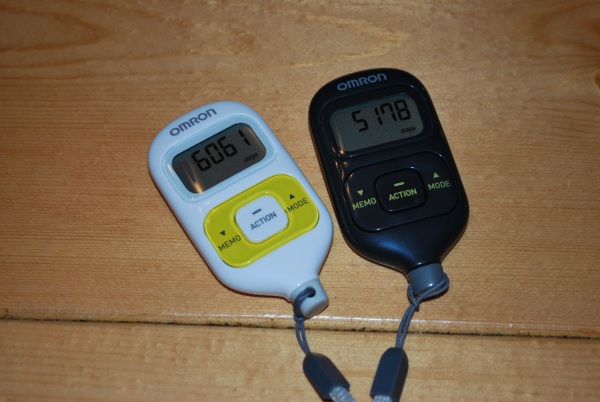
Mine's the yellow one. No. Really.

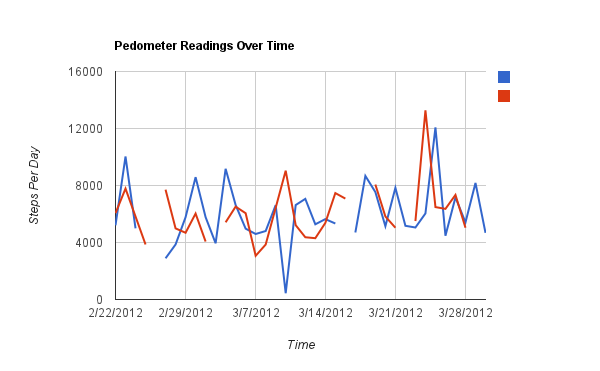
In an effort to try to monitor our physical fitness (or lack thereof), we opted to get a few pedometers so, at the very least, we know how much walking we’re doing every day.  The goal is 10,000 steps in a day, which is, on average, around 5 mi.  On our first day, you can see we didn’t quite hit that…

Part of the issue I’m having is in placement of the pedometer.  It comes with a ~4 in strap with a clip on the end, so it’s easy to put in different places.  These particular pedometers operate on two axes, so you can’t just leave it in your backpack or purse: you have to have it in a vertical position, not horizontal.  As such, on the first day, I put the pedometer in the small change pocket of my corduroy pants.  The second day, I put it in the change pocket of my slacks, however that pocket is down inside the main pocket, not up higher on the hip.  On that day, I recorded over 10,000 steps, though I don’t think I really doubled my steps over the previous day.  On Friday, I tried clipping it to my belt and having it hang into my left pocket and I was back down to around 5,000 steps again.

My guess is that the constant motion of my legs, due to over a decade of drumming, could affect the pedometer, but I probably won’t know that until further data comes in.  These pedometers save 7 days worth of data, but I’m recording it in a Google Docs file so we get a more “visual” interpretation of our progress.

Today, I’m wearing a dress shirt, so I have the pedometer clipped up on my torso, hanging down underneath my shirt.  This is the last position for a pedometer I can think of, and probably isn’t all that good of one, as your torso tends to stay more “stable” and feel less movement than your legs do.  That’s what a few years of marching percussion leads to, at least…

Anyway, I’ll probably post from time to time on this.  It’s my first time trying to use a pedometer.  Brooke used one after we first got married but stopped using it.  We figure that if both of us are using one, it’s easier to hold each other accountable, at least to some degree.

Still, it’d be nice if there were a GPS and Wifi-enabled one that could upload the data to some remote server once a day.  Sure, I could use my phone for this purpose, but it’s quite a bit bigger than these pedometers, and most people don’t want to clip a phone to their bodies… 😛

On Foisting Morality

I should note that Brooke doesn’t agree with various aspects of this post.  My opinion and mine alone!

Brooke and I have had more than a few conversations about the “birth control mandate” controversy from the last few weeks, where the Obama Administration required under the Affordable Health Care Law that all employers, including Catholic Hospitals and Universities, are required to provide birth control as part of their health care coverage to employees.  Various Catholic organizations, and others, protested this requirement, so the Administration compromised in allowing these organizations to avoid paying for the coverage as part of their contracts with health insurance companies, however, the insurance companies themselves would need to provide the coverage to the employees of these organizations.

While some felt this compromise was an example of the Administration deftly maneuvering around a touchy issue in an election year, others felt it still went against the rights of the employer to deny coverage they deem to be immoral.

It was this “immorality” part that yesterday’s On Point Radio show on NPR took on, interviewing a Pro-Life representative, a Pro-Choice representative, and a Bioethicist about the issue, from a moral, non-religious standpoint.

One of the callers caught my attention as making my point better than I could ever hope to make it.  Sadly, there’s no transcript, so I can’t put it on here verbatim, but it transpired late in the podcast.  An employer called in with a hypothetical situation, based on one of his employees’ experiences.  He was quick to point out this was a “Devil’s Advocate” kind of position, but it illustrates what concerned him about legislation currently moving through the House and Senate that would allow employers to “get around” what the Obama Administration had put in place and deny coverage under a “conscience amendment.”

Suppose that an employee is under their employer’s insurance.  That employee finds out that they are pregnant, and further finds out that they are having a child with Down’s Syndrome.  The employee decides to go ahead with the pregnancy and delivers the baby.  As this actually happened, the employer (the caller) had access to the bill, or at least, what the insurance company ended up paying: right around $300,000.

So, on a moral ground, the employer could say “You know, I think it’s immoral to make other people in this company’s insurance network fork over the $300,000 to pay for this hospital visit.  It’s okay if you, the employee, want to give birth, but it’s immoral for that cost to get shifted over to the insurance company.  You, the employee, should have to pay that $300,000.  That’s your right to pay for it, but it isn’t your right to make your insurer pay for it.  On moral grounds, I don’t think you should have had the baby.”

Again, this particular employer wasn’t advocating this position, but it’s illustrative of what a law like this would allow: employers could deny any coverage they thought was immoral.  That means a company run by Jehovah’s Witnesses could disallow blood transfusions to its employees.  That means a bigoted employer could deny AIDS treatments because you’re a homosexual.  That means an employer (or insurance company), like in the hypothetical above, could say an abortion was more moral than the delivery of a disabled child.  And that means a Catholic organization could deny birth control to women with ovarian cysts, likely dooming them to infertility.

That’s why this mandate exists and that’s why it’s necessary: not to force companies to do something, but to ensure that the morals and/or religious ideology of companies and employers aren’t foisted upon you, the employee.  It’s freedom of religion and freedom from religion.  Even Protestants recognize that favoring one religious community will affect another.

People, as a group, have a right to health services.  It isn’t up to the employer which services you are allowed to get: it’s between you and your doctor.

Let’s keep it that way.

Primer: Electrophysiology

These posts, tagged “Primer,” are posted for two reasons: 1). to help me get better at teaching non-scientists about science-related topics; and 2). to help non-scientists learn more about things they otherwise would not.  So, while I realize most people won’t read these, I’m going to write them anyway, partially for my own benefit, but mostly for yours.

It’s been awhile since I posted one of these, but as I’m working on radically different science than I have in years past, and people ask me “what I do,” I figured I should take the time to explain, to some degree.

Wikipedia defines “electrophysiology” in the following way:

Electrophysiology (from Greek ἥλεκτρον, ēlektron, “amber” [see the etymology of “electron”]; φύσις, physis, “nature, origin”; and -λογία, -logia) is the study of the electrical properties of biological cells and tissues. It involves measurements of voltage change or electric current on a wide variety of scales from single ion channel proteins to whole organs like the heart. In neuroscience, it includes measurements of the electrical activity of neurons, and particularly action potential activity.

So, in the most general sense, I’m “listening to neurons talk to each other,” and occasionally, “interrupting their ‘conversations'” in various ways.  When I talk about “conversations,” I’m referring to the act of neurotransmission, whereby one neuron sends a chemical signal across a synapse to another neuron, resulting in the propagation of that signal (an action potential), or sometimes the inhibition of another signal.

As I talked about in a previous primer, in order for an action potential to occur, various ion channels in the membrane of a neuron must open, allowing sodium (Na+) from outside the cell to come in, and potassium (K+) to go out.  Other ions will play roles as well, including chloride (Cl-) and calcium (Ca2+).

Using electrophysiology, it is possible to measure the movement of these ions across a cell membrane using relatively simple principles of physics.  Specifically, [V=IR], or [voltage = current X resistance].  If you hold two of the terms of this equation constant, it is possible to determine the third term.  Effectively, we do this using a “patch pipette,” a small, sharp, glass tube that has a wire electrode running through it.  If you know the resistance of the pipette, and you hold the electrode at a constant voltage, you can measure the current across the membrane of a cell (i.e. the flow of ions).

In short, this diagram describes the actual process of making this measurement, using a technique called “patch clamp“:

Looking through a microscope (like the one pictured above), you move one of these glass electrode pipettes to be just touching the membrane of a cell.  You have to be very careful so you don’t puncture the cell, thus damaging the cell membrane to the point where you can’t make accurate measurements.  You then apply a small amount of suction using a syringe to actually suck some of the cell membrane inside the pipette.  Once you have a strong seal formed (typically termed a “gigaseal”), you can apply a brief, large amount of suction with your syringe to rupture the membrane of the cell, where now, the inside of the cell is being exchanged with whatever you put on the inside of the pipette.  The internal solution of a pipette is usually something like potassium, basically trying to recreate what the inside of a cell would be, aside from all the organelles, however you can add compounds or drugs to manipulate the actions of channels you are trying to study.  Typically, though, you apply drugs to the outside of the cell, as well.

So, a real-world example of how this technique is used would be in my study of NMDA channels.  The NMDA receptor is a sodium channel and is very important in neurotransmission, but especially in memory.  When I have a cell “patched” like in the diagram above, I can apply the drug, NMDA, to the cell and see a large sodium current on my computer screen, kinda like this one.

So, over time, when a drug like NMDA or this “Blocker” is applied, you can see a change in the current (measured in “picoamps”) across the membrane of the cell.  In this case, we would read these data such that NMDA opens its channel and sodium ions flood inward, then that current is reduced by the “Blocker” that was applied for a few seconds, and then once the application of the “Blocker” was stopped and NMDA alone was applied to the cell, the inward sodium current increased again.

These traces allow you to get information about how channels are opening, what ions are flowing in what direction, and to what degree drugs like this “Blocker” are affecting channels.  It is work like this, for example, that led to characterization of benzodiazepines and barbiturates, drugs that interact with the GABA receptor, a chloride channel.  Without these techniques, it is difficult to know how a drug is affecting a channel at the cellular level.  Just about every cell in your body has channels of some kind, as they are very important for maintaining the function of that cell.  Neurons are just highly specialized to require ions more than some other cells do, though heart cells are also studied in this way, among others.

Effectively, these techniques allow you to determine how a cell works.

Protip

"Hello. My name is 'Google Reader.'"

I’m fully aware that many believe I sit in front of a computer all day and stare at Facebook, posting articles and comments and shirking actual “work.”  In actuality, I’d argue that I only have “http://www.facebook.com” on my web browser 15 min per day, on average.  On a “busy” day, when I’m in the middle of a conversation/argument, more like 30 min.

How is this possible, you ask?  Why, it’s the power of RSS readers!

“RSS” stands for “Really Simple Syndication,” and the idea for it goes back as far as 1995, though the first official version was integrated into Netscape in 1999.  In many ways, RSS is what gives blogs the power they have today: the ability for the headline and a brief description of an article or posting to be “aggregated” for easy digestion by the reader.

Note: This very blog has and has always had an RSS function.  That’s what the cute little orange icon in the upper-right corner that pops up does.

So here’s the secret:  I’ve got 45 different blogs aggregated into my Google Reader account.  This means that my phone, my Kindle Fire, my Chrome web browser, and the Reader website itself all tie into a single repository that collects new posts from each of these sites almost immediately after a new article is posted.  I’ll wake up in the morning and have 75+ articles to wade through, to see if there’s anything interesting, and I can do this easily on my phone, swiping with my finger to scroll through the list.

Any articles I think may be interesting (based on the title, usually, but sometimes after checking the description), I will press to add a “Star,” effectively bookmarking it for later reading.  Then, I can just click “Mark All Read” and my list is cleared out, ready for re-population.  Once I sit down at a computer somewhere, or with the tablet, I will then skim the articles I found to be most interesting.  And sometimes, I’ll share relevant articles on Google+ or Facebook.

So, quite rapidly, I can skim through articles from the St. Louis Post-Dispatch or the Columbia Daily Tribune without ever having to actually visit the sites themselves, thus avoiding ads and thus saving me time.

And furthermore, you can share articles to Facebook or Google+ directly from most of these blogs, as this is how they generate their traffic.  You just have to click “Share” from the page in question, or from within Google Reader.  A little box shows up and you write what you want to post, along with the link.  And you never have to actually go to Facebook.com to do this.

So yeah, a little “protip:” use an RSS reader of some kind to make your blog reading more efficient.  You are more than capable of getting information throughout the day without getting bogged down in Facebook or on blogs themselves.  You can, in fact, get work done and still provide useful information on subjects that interest you.  It really isn’t that hard…

Pirates on the High Seas (of the Internet)

I read a pretty spectacular article from Forbes.com today about how the MPAA and RIAA are fighting a losing battle against piracy.  The article echoes statements I’ve made in the past, though not on this blog (…that I can find, anyway…).

The author is blunt and to the point: the movie industry is being dragged kicking and screaming to a future that practically all their customers want, and they’re losing revenue in doing so.  They could make their money back on volume by making their movies a). easier to access, and b). cheaper.

The primary problem movie studios have to realize is that everything they charge for is massively overpriced. The fact that movie ticket prices keep going up is astonishing. How can they possibly think charging $10-15 per ticket for a new feature is going to increase the amount of people coming to theaters rather than renting the movie later or downloading it online for free? Rather than lower prices, they double down, saying that gimmicks like 3D and IMAX are worth adding another $5 to your ticket.

They have failed to realize that people want things to be easy. Physically going to the movies is hard enough without paying way too much for the privilege. Going to a store and buying a DVD instead of renting or downloading is generally an impractical thing to do unless you A) really love a particular movie or B) are an avid film buff or collector.

Here’s the part I’ve been most concerned by: rising ticket prices.  Why go to a movie theater to spend $10-$15 on a ticket, plus an additional $10+ on “food?”  Granted, I have a toddler so my movie viewing in theaters has decreased tremendously in the past few years anyway, but with the advent of Netflix, I have all kinds of things to watch, and now I have the will to wait until a movie comes out on DVD.  Especially when the summer blockbusters are looking more and more like that “Battleship” ad you saw during the Super Bowl.  Now, if I could see a non-IMAX, non-DTS movie in the theater and get a medium-sized non-refillable soda for $10?  I’d do that.  No question.

Finally, the author suggests a solution to this problem: the movie industry needs their equivalent of the gaming industry’s digital distribution platforms (e.g. Steam). Heck, they need Apple’s iTunes.  Make buying the product so stupid simple that it takes less effort to buy it than it does to steal it.  As he points out, it takes 7 steps to download a movie illegally, and depending on your internet connection, you could have an HD-quality movie in a half hour.  If the movie industry would just get behind an Apple or Amazon model of 1). find movie, and 2). click “buy” (for a reasonable price).

Let us recall music piracy of the late-90s/early-2000s for a moment.  Back then, you could go on Napster or Kazaa and search to find music you wanted, but you’d easily find tens or hundreds of the same track, each one with different sound qualities.  You could easily download a track you thought was good, but after downloading, you’d find actually had multiple “hiccups” in the file.  iTunes streamlined the process.  Search to download one song that you knew was of relatively high quality and was consistent with the rest of your iTunes library.  Moreover, you’d see that you could get a song for $1, but the entire album for $10, undercutting what was easily $15 at most brick-and-mortar retailers.  So in many respects, at least with iTunes, there was a chance you’d “up sell” your customer on getting the whole album, rather than just a single song.

iTunes made it easy and people flocked to it.  Does music piracy still happen?  Absolutely, but now, people have a reasonable, viable alternative that I’d argue most people consider before pirating albums.

Steam did the same thing for the gaming industry, making it stupid simple to download a digital copy of a computer game without having to search through seedy sectors of the internet looking for a pirated copy (that could include viruses or other malware).  They can even upgrade your graphics drivers and more for you when you install the game, streamlining the process further to make life for the consumer that much better.  Many PC games are released day and date with their “physical media” counterparts.  In many cases, you can actually have the game downloaded and then get it “unlocked” at midnight on its release day.  For PC games, you can’t get much more convenient.  You don’t even have to get out of your pajamas…

If piracy has taught us anything it’s that the movie industry thinks that an audience watching their movies on a computer or TV screen, while that same movie is still out in theaters, is important.  If this is really the case, the movie industry should do the smart thing and release movies online day and date with their release in theaters.  Charge $10 to rent it, making the cost comparable with a ticket to the theater (though that $10 is then divided up among the number of people watching the movie in your living room).

Obviously, some people don’t care if the movie is in IMAX or has super-duper Dolby Digital Sound or smell-o-vision: they just want to watch the damned movie.  They don’t want to deal with crappy popcorn prices.  They don’t want to deal with screaming kids or people talking through the whole thing.  They don’t want to fight for a decent seat in a packed theater.  They don’t want to drive their car and park in a lot.  They don’t want to pay upwards of $30 to see a movie on a Saturday afternoon.  There are any number of reasons folks don’t want to go to a movie theater, while others still like going.  There’s no reason the movie industry can’t cater to both demographics and make money doing it.

So, take heed, Movie and TV Industry. You’re being surpassed by other content purveyors.  Make it easy to access your content and I assure you, people will return to you and buy more of your stuff.

And stop taking your anger out on Netflix…that isn’t helping anything…

Cabin Fever 2012

This is an India Brown Ale in the tasting glass you get for attending the event. Mmmm!!

We went to Schlafly’s annual Cabin Fever event this past weekend at their Maplewood restaurant, the Bottleworks. It’s always held around this time of the year as their Winter Festival, featuring somewhere around 30 of their beers.

Generally, you pay $25 for a ticket (or $30 at the door, but it’s always sold out if you wait that long) and, in exchange, you get a nifty tasting glass and eighteen 2 oz samples of various beers.  As it’s wintertime, the beers tend to be “high gravity,” meaning they’re a bit heavier and tend to have a higher alcohol content.  They always have a few of their lighter beers on tap, too, but the big draw is their other fare.

Now, you say, “well Andy, that doesn’t sound like very much beer for the money you’re spending.”  To a degree, you’re right, but the kind folks doling out the beer are kind enough to a). “forget” to bring along a Sharpie to mark off your ticket, and b). start at 2 oz of beer, and as the afternoon wears on, the volume increases.  So in the end, you can get plenty of beer and taste just about anything you want to.

In the Picasa album that’s accompanying this post, you’ll see pictures of the list of beers that were available, including a brief description of each one, and my own marks to show which ones I had.  You’ll see that I actually did get all 18 beer tastings…

…but my ticket only had maybe 5 of them marked off…  😛

There were quite a few great beers on that list that we tried.  The India Brown Ale (pictured above) was probably my favorite, as it was pretty different from others I’ve had before.  The similar, yet different, India Wheat Ale was also pretty good, but the hops didn’t seem to gel as well with the “wheat beer” flavor as it did with the “brown ale” flavor as before.  The Raspberry Coffee Stout was also exceptional, with a flavor leaning closer to the “raspberry” than the “coffee,” yet not as fruity as you might expect.  I had figured I’d prefer the Strawberry-Cocoa Porter over the Stout, but alas.

The Southern Hemisphere IPA was also shockingly good, mostly because it tasted recognizable, yet different. I mean, it was hoppy, as you’d expect, but the hops they used were something from Tasmania called “Galaxy,” so it turned out to have a very different flavor profile than other IPAs I’ve had in the past.  Believe you me, I hope they put that beer in bottles so I can get more of it!

Regardless, the event was quite fun.  Granted, the weather turned out to be cloudier and cold(i)er than the forecast had led us to believe, but with some good friends to crowd around and some strategically placed fire pits, we weren’t bothered all that much.  That, and high gravity beer tends to keep you all warm and fuzzy on the inside.

If you want some additional pictures of the event, STLhops was there taking pictures.  We even made it into one of them!

That's Stu, Brooke and my bald head off to the right...

I expect you all to go along next year. 🙂

Internet Bi-Partisanship

By now, surely you have read and/or heard plenty about the Stop Online Piracy Act (SOPA) and the Protect IP Act (PIPA). These two bills were heading through the U.S. House and Senate (respectively) and seemed destined for passage as recently as last week, with the first votes coming up next week.

Also, as you probably know, a shutdown of Wikipedia, Reddit, and other popular websites (as well as a host of other “In Solidarity” messages on homepages across the web) managed to galvanize support against the bills that has never been seen before.  In a single day, Google.com collected over 7 million signatures on an online petition.  Rather than the English-version of the website, Wikipedia redirected you to a list of your Congressional representatives and senators so you could either phone or e-mail them (I sent e-mails to all of mine; heard back from two of them, so far).

I don’t want to belabor how bad the bills are (or now were).  They were pretty bad.  They were so vague as to allow for entire websites to be brought down, or at least to make it so cost-ineffective to host any interaction with users and consumers (for fear of copyrighted material being posted) that an entire industry of user-generated content would die.  I highly suggest you watch the video above if you want to understand the issue fully.  If you’re an internet user in any capacity, it’s an important 13 minutes for you to spend.

Mostly, I wanted to address how ridiculously cool it was to see the entire internet united, even if for only one day.  For that 24 hr period, this is all anyone was talking about across social networking.  For that 24 hr period, people were engaged in the politics of what was going on with an issue that applied to them directly.  For that 24 hr period, it didn’t matter if you were a Democrat or a Republican posting on some message board: both political parties supported the bills, and both party’s voters were against it.

For that 24 hr period, the internet and its users had more political power than the lobbyists from the motion picture industry and the music industry.  And that’s saying something.

We’ve seen something like this before, in the form of the Arab Spring nearly a year ago, where social networking and the internet helped spawn a revolution across the Arab world, in multiple countries, casting down dictators long thought to be invincible by their people.  Their citizens got organized, coalesced behind a belief that they could make a difference in their lives, and decided to take action.  And in some small way, the internet did the same thing for the people of the United States this week.

And I just think that’s kinda cool.

Another Reason to Buy American

A few months ago, I started listening to This American Life, a weekly Public Radio International show typically broadcast on NPR (Sundays around here, I think). Back in late July, they broadcast an episode about “patent trolls” that was particularly engaging, so I’ve been hooked ever since.

Last week’s episode, which I highly suggest you listen to, focuses on manufacturing in China, specifically, of products in Shenzhen.  Products from Samsung, Dell, HP, and more specifically, Apple.  Mike Daisey is something of a story-teller, so he gets up on stage in front of live audiences and talks in one-man shows.  As an Apple lover, he expounds upon his history with their products and how he always sought to understand how his iPad, iPhone, MacBook Pro, etc. worked, even going so far as to take his laptop(s) apart, clean them, and put them back together.  Through various circumstances, it occurred to him that he knew very little about how these products were actually made, however, so he took a trip to Shenzhen to visit the Foxconn plant where practically all Apple products are manufactured.  As others have reported in the past, he found harsh working conditions, that unions were illegal, and that underage girls were employed in the factory.

More to the point of what I’m getting at, Daisey says that Apple is actually doing relatively well with their manufacturing practices, holding yearly audits, requiring that their manufacturers follow strict guidelines, and so on.  Others in China and Southeast Asia, as a whole, aren’t as careful.  Some have even suggested that, while these practices are obviously unfortunate, in many ways, it still provides a better living than these individuals had prior to industrialization.  And furthermore, in many ways, these countries are currently ascending much as the United States did in the Industrial Revolution.  It’s something of a “growing pain” that countries must go through before they can decide what work practices will be most efficient for the company, and most beneficial to the worker.

This issue is something I’ve never associated with the idea behind “Buy American,” or at least, “Buy From Companies You Know Are Providing Some Level Of Non-Exploitative Treatment To Their Workers.”  Many (most?) manufacturing plants in North America are pretty good about treating their workers fairly, with some limit on hours worked, over-time pay, a minimum wage, and so on (depending on unionization and other factors, of course).   There are a variety of European companies that do as well or better in the treatment of their workers, and I’m sure there are even some in Asia that do right by their employees.  While I’m suggesting a focus on looking into the manufacturing processes of companies we tend to buy from, I just see the whole endeavor as another reason to just Buy (North) American.

Up until now, I always thought of it as an economic issue, to keep our money here rather than sending it overseas.  Increasingly, this is difficult as manufacturing jobs have all but left the U.S.  Even when we “Buy American” in things like cars, they’re only assembled here: all the individual parts are built/assembled overseas.  But after listening to this particular story, it makes me consider other reasons to try buying American-made/grown products, where feasible.  Unfortunately, it’s probably impossible to buy a TV, an MP3 player, a computer, or a phone that was assembled, let alone built, in the U.S.  I guess I’d like to see the “Buy American” ideal extended so it not only encompasses the economic need to keep our money here, but also the need to extend the rights of workers and the belief that each individual has value to the countries that make all the “stuff” we keep buying.  Perhaps something like the “Fair Trade” label used on food products from around the world: a certification process companies can apply for to provide some degree of protections for the people they employ.

I dunno.  I just never really thought about the concept of “Buy American” as a way to reward companies that treat their workers well.  Perhaps we all should.

Edit: In mid-March, This American Life had to retract their initial report, listed above, saying that Daisey had fabricated enough portions of his monologue that they deemed it unfit for their journalistic standards.  Generally speaking, things like chronology, specific interviews, and certain details were fact-checked with his translator, Cathy, who told This American Life that it didn’t all happen in that order or in that way.  They interviewed Daisey again in the podcast from that week, who felt badly for the ordeal, but wanted to make sure people realized that the things he said are “true” in that they happened at Apple plants: just not necessarily on his particular visit.

Trying Out A New Toy

A little snow won't dissuade the determined brewer.

For mid-January, yesterday ended up being a pretty gorgeous day for brewing. The sun was shining (occasionally) and the temperature held in the mid-40s for most of the afternoon. Thus, with Brooke and Meg out of the house, I opted to make the Chinook IPA Mom and Dad got me for Christmas.

This time, however, I also got to try out one of our new immersion wort chillers, so I figured I’d take the time to explain what this thing does and how to use it.  Generally, you boil your wort (i.e. unfermented beer) for about an hour, and you add hops and other components during that period.  However, you can’t add the yeast until the beer has cooled to below 100 F, though preferably closer to 80 F.  You need to cool it down as rapidly as possible, so you can hopefully get it into your sealed fermentation vessel as soon as possible, including yeast.

For previous batches, we’ve always just put that big 5 gal. pot in an ice bath, though we’d have to add additional ice and cold water throughout, frequently taking well over an hour to cool down.  Here’s where a wort chiller comes in: you run cold water through its copper tubing to act as a heat exchanger, removing heat from the wort quickly as cold water takes it away.

As this was my first time using said device, I had to do a few things first, namely, clean it.

Wort chiller, bathing in diluted white vinegar.

In the process of manufacturing, the copper tubing tends to have coatings of various oils and oxidized gunk that you don’t really want in your beer.  Reading from John Palmer’s “How To Brew,” I found that before you use the chiller for the first time, you need to clean it with some kind of industrial copper cleaner, or alternatively, just use distilled white vinegar.  The oils and oxidation products tend to come off the tubing in acidic solutions, and as beer is slightly acidic, all that stuff would end up in the beer.  Thus, bathing the chiller in diluted vinegar (the stuff from the store is 5% acetic acid) shines it up nicely.

After soaking for maybe 20 min in vinegar, I rinsed it off well and let it air dry while the beer was boiling.  When there’s about 10 min left in the boil, I then put the chiller in the brew pot, so the act of boiling would help sanitize the chiller.  Though I’d just cleaned it in vinegar, there could still be some “bugs” on the outside of the tubing, so the boiling should take care of it.

Once I’d reached the end of the boil, I carried the pot and chiller down to the basement and hooked it up to a sink using an old washing machine hose.

Looks appetizing, eh?

Cold water going in and through the tube, then coming out the other end.  I didn’t have a hose that fit that end of the tubing, so I just make sure to only keep the water pressure at something manageable, so it would stay within the sink.

The wort cooled down in about 20 min.  Good deal!

Now that the chiller’s been cleaned before, I shouldn’t have to soak it in vinegar again, though forum posts on the interwebs will tell you that some people insist on cleaning it every time.  In theory, all you should have to do is rinse it with water, then put it in the wort for 10 min while it’s boiling, then rinse it once you’re done.

All in all, it was remarkably easy and cut down on some of the total time spent brewing.  Now, we’ll just have to wait another month or so to see how the beer turned out!

Don’t Hate The Band, Hate The Fans

I don't think these guys get it...

I’ve heard this argument before: “I don’t hate Dave Matthews Band, but their fans are so annoying!”  As in, the music isn’t beyond the realm of their enjoyment, but the people they have to enjoy it with are so terrible that it detracts from the intended experience.  The same could be said for a variety of other acts, I’m sure.

Except in the case of Coldplay.  Both their fans, and the band, are terrible.  But this should go without saying.

Increasingly, I find myself seeing a connection between this feeling toward music and toward religion, especially in the case of Christianity.  All too often in today’s culture, I feel ashamed by what seems to be the impression that Christianity sometimes portrays to the world at large.  Folks like those above, admittedly from the fringe group, the Westboro Baptist Church.  Do all Christians feel this way?  Absolutely not.  Yet any time they get attention, there are folks out there that think this is what Christianity is all about.  Much of the same can be said of Islam, where a few bad apples end up making the rest of the world fear a largely peaceful and just faith tradition.

There are examples like this guy, too:

...neither does he...

Again, I’m sure he’s in the minority, but when pictures and videos of this nature hit the internet or television, the message being spread isn’t “Love” and “Acceptance:” it’s “Retribution” and “Intolerance.”

I think I’m most sensitive to this issue when it comes to homosexuality and the Church.  I know a few folks who are gay, and they’re really good people.  Personally, I’d love for them to be able to go to church.  And I know some of them would like to.  But, their impression, based on images like those above, and from conversations they’ve had with other Christians, means they’ll probably never go.  These are people that want to learn more and want to get the same experiences that I’ve had throughout my life, but feel like they can’t, because they’ll either be turned away, or at least told that their lifestyle is going to send them to Hell.

Since when are the Christians the ones doing the persecuting, eh?

I’m tired of these folks above representing me.  Of having some bearing on how my faith and traditions are perceived by the world at large.  These people do not represent the whole of Christianity.  Nor does the feeling that homosexuals are evil.  Nor does the feeling that women who have an abortion are going directly to Hell.  These feelings are indicative of unacceptance, of intolerance, and of hate.  In my opinion, they are inherently unchristian beliefs.

To those people that want to quote Old Testament scripture or the Letters of Paul (neither of which are words of Jesus, for the record…), I give you this:

12 So in everything, do to others what you would have them do to you, for this sums up the Law and the Prophets.     — Matthew 7:12; NIV

36 “Teacher, which is the greatest commandment in the Law?”

37 Jesus replied: “‘Love the Lord your God with all your heart and with all your soul and with all your mind.’ 38 This is the first and greatest commandment. 39 And the second is like it: ‘Love your neighbor as yourself.’ 40 All the Law and the Prophets hang on these two commandments.”  — Matthew 22: 36-40; NIV 

That is the Christian message, as I see it, straight from the mouth of Jesus Christ.  Treat others as you want to be treated.  Love God and love your neighbor as yourself.  These are the important aspects of Christianity, and if you follow these tenets, then you are not only a good Christian, but you’re also a good human being.  Unsurprisingly, the Golden Rule transcends Christianity and applies to other world religions, as well.  It’s just one of those things you should do.  Christians included!

These feelings always get stirred up around election season, when I see self-righteous “family candidates” like Rick Santorum up on a stage, talking about “family values” while denouncing pro-choice women and homosexuality, among other things, all the while representing Christianity on the world scene.  I’m appalled by the things this guy says, in the name of Jesus Christ and in the name of the Christian faith, as a whole.  I just hope that people around the world don’t think he, and others like him, are representative of all Christianity.

They’re not.

To anyone reading this that has been wronged by people in the name of Christianity, then I sincerely apologize.  I just hope anyone that knows me, or Brooke, knows that we’re Christians and we don’t feel the same way as those that seem to represent us.

And we aren’t alone.