
A Change of Pace
I participated in our church’s cantata this past weekend. I was asked awhile back to play along in some capacity, whether it was guitar or percussion, and I opted for the latter after finally listening to the recording on the way back from Thanksgiving. I’m particularly glad for this because the guy that ended up playing guitar had to deal with songs in terrible keys – drums don’t tend to play chords, so I was all good. The choir held practices on Wednesdays in December, which were difficult for me to attend due to Brooke’s ever changing work schedule and the need to keep Meg on some semblance of a sleep schedule. Therefore, I went this past Wednesday, practiced with the group this past Saturday, and then performed the cantata on Sunday. When we actually performed the thing Sunday morning, I still hadn’t actually played the first two songs. Par for the course.
Regardless, it turned out surprisingly well. I used my djembe, congas and bongos, which fit pretty well with the piano lead, and guitar and synthesizer accompaniment. I fit into the background, but still added to the experience in my own way. I also got quite a few compliments following the two services we performed it in. Overall, the choir did a great job and the music was very well received.
The whole thing brought up some memories, though. For the last 10 years or so, my musical experience has centered around praise bands. This would involve your typical “rock band”-style musical system, with a few vocalists, electric/acoustic guitars, bass guitar, maybe a piano and some drums. There would be a leader, but that leader would also be playing an instrument, so for the most part, the band would be a, theoretically, cohesive group that didn’t really need a prototypical director to run it. Many times, it became an “organic” experience and evolved as we performed each song.
This group at the cantata, however, needed a prototypical director. And it’s been awhile since I’ve needed to follow one.
Generally, I was trying to follow the piano player, as she was the lead instrumentalist, but she was trying to follow the director, who was mostly directing the choir. The piano, however, wasn’t really oriented toward the director, so while the piano player was keeping time as best she could, she couldn’t easily look over and see what the director was doing. And the director was doing her best to fight timing between the piano and the choir, with all their individual singing and speaking parts.
It very much reminded me of playing in the pit orchestra back in high school. And in a good way.
There is something indescribable about that kind of experience. The feeling of playing a part in a production. Not necessarily an up-front acting gig or anything, but still participating. Some of my fondest memories of high school go back to playing in the pit orchestra for the likes of “West Side Story,” “Brigadoon” and “How To Succeed In Business Without Really Trying.” We had weekly practices, eventually leading to daily practices that went relatively late into the night (a school night…so…”late” meaning 9:00…) all culminating in the set of scheduled performances. People would get all “psyched up” and go through their various traditions and rituals that have been passed down from performers of yesteryear. We, being in the orchestra, all wore black so we wouldn’t stand out in front of the actors.
In many ways, it was an almost magical experience to go through. When those songs came together, you could really get shivers down your spine. Again, we’re talking about a group of 50 people or so taking on different jobs to pull together a singular vision. In some ways, it’s like a football game. Each player gets their own part to play, but they all have to work in concert to make a truly awesome play. The same goes for a musical. You may have 15 people playing different instruments, then another 20 or so up on stage, some singing, some dancing, and then a whole host of other people backstage pulling the rest of the show together, sight unseen. When it works, it really works. And you are astounded every time you do it, as one wrong note, or one wrong line, or one misplaced prop can shatter the whole thing.
To be fair, being in a church cantata, while fun, isn’t the same. We practiced quite a bit more for musicals, production took months, they had to hold try-outs, and so on. However I got the same kind of feeling playing along yesterday. A feeling of playing along with a large group again, not necessarily out front, but in the background playing my part. It was cool to simply be there and have a good time. Strangely less stressful than playing with a smaller group on a typical Sunday.
I guess it was just good to play my instrument(s) as part of a larger whole again. It doesn’t happen often enough anymore.
Over The River and Through The Woods…
Needless to say, this year marked quite a few changes for us. The birth of Meg and our move to Iowa have complicated Christmas travels to a greater degree than they used to be. Way back when, we would go to Hannibal/Louisiana for Christmas Eve and then rush back to Columbia/Lohman for Christmas lunch with the Plochberger side of the family. As my grandmother passed away earlier this year, we will no longer be getting together for Christmas Day in the same way that we have in the past, likely doing something like a traditional “Family Reunion” once a year at some other time. Therefore, we won’t have to rush back so quickly Christmas Day. That part is a bit easier. It’s the rest of it where things get interesting.
This year presents other issues. Firstly, my buddy Andy S. got married earlier this year. We were unable to attend any of the festivities, largely because Brooke was quite pregnant, so I didn’t really want to be out of town for an extended period. He and his wife, Rachel, are hitting Columbia (and our mutual friend, Brett), but only for the week prior to Christmas Day. Therefore, here’s how this is going to work:
- Meg and I will drive down to Columbia on the 21st so we can see some folks prior to Christmas (~5 hr drive)
- Meg and I will drive to Hannibal on the 23rd; Brooke and Edie will meet us there (~2 hr drive)
- We spend Christmas Eve in Hannibal/Louisiana, get up Christmas morning, open presents at the Baumann house, and then head off to Columbia (~2 hr drive)
- We stay in Columbia through Monday and return to Iowa by way of Hannibal, picking up Brooke’s car (~5 hr drive)
So yeah, it’s gonna get kinda crazy…at least, crazier than it’s been in previous years. It’s a good thing that we have a larger vehicle now so we can carry stuff with us between locations, but it’ll be nice having two cars in Missouri so we can load them both up to get everything back up to Iowa.
This brings us to another issue: space. As in, we have very little. Meg, for all of the 17 lbs that she weighs, comes with metric tons of stuff. As in, multiple bags of clothes, blankets, a baby cage (read: “pack ‘n play”), and toys. And we still have Edie to take along, too. And presents for 3 people for the ride home (but presents for 9 people on the way there). We’re probably going to have to pick up a car-top carrier before we even consider going on vacation next summer.
Related to all of this, we probably won’t travel much in January/February, for a few reasons. One, we live in Iowa. Iowa is cold. Really, really cold. The 3″ of snow that fell today will probably still be here in March. So yeah, we’ll probably stay bundled up and keep as warm as possible, without going anywhere besides work. The other reason (the real reason…) is that Meg hasn’t been traveling well recently. It just seems like we go places and she gets off whatever sleeping schedule we finally settled her into, then it takes at least a week to get her back to something semi-normal. She also tends to get sick, in some fashion, shortly thereafter. I’m sure a lot of this is related to the teething (that she’s finally showing some progress in!), but the constant traveling can’t help. It just seems like we make some progress at getting her to a normal routine, and then it’s dashed within a weekend! We have gone to Columbia, Hannibal and St. Louis a few times over the last few months. She generally does fine in the car, and is great for most of the day, but overnight…eeeeeeesh…
So yeah, that’s this year’s plan. Weather/sickness depending, as usual. We’re just going to make a concerted effort to get through it all mostly unscathed, survive winter, and make it to Meg’s first birthday. Mark your calendars for March 5th!
This whole “War on Christmas” thing…
| The Daily Show With Jon Stewart | Mon – Thurs 11p / 10c | |||
| The Gretch Who Saved the War on Christmas | ||||
|
||||
For some reason, this week marked the first time in 2010 that I heard mention of this year’s “War on Christmas,” first in church and then in the “Daily Show” clip embedded above. At church this past Sunday, it was proclaimed twice (not by the pastor) that we should all remember that “Jesus is the reason for the season” and that we should all say “Merry Christmas” rather than “Happy Holidays.” In the clip above, Jon Stewart highlights Fox News’ personality Gretchen Carlson as going off on the city of Tulsa, OK for changing the name of their 70-year-old annual “Christmas Parade” to the “Holiday Parade”…back in 2009…
Now, don’t get me wrong, I understand the frustration. Christmas is a holiday celebrating Jesus’ birth and, thus, is a Christian holiday. And this Christian holiday has been hijacked by all these other groups, including the atheists that believe in Santa Claus, or the Jews and their Hanukkah celebration. We should all stand up against this onslaught and proudly exclaim “Merry Christmas” to everyone, and help ensure that we get a “Merry Christmas” back instead of the more generic “Happy Holidays” (you know, ’cause there’s only one real holiday…so we can’t make it plural). <end sarcasm here>
As the last half of the video above suggests, this trend is hardly new. If you watch many of the old classic Christmas movies, including “Rudolph,” “A Christmas Carol,” “How The Grinch Stole Christmas,” etc., you won’t find much mention of Jesus. Only “A Charlie Brown Christmas” comes to mind in mentioning it at all, with the iconic recitation of the Christmas story by Linus, but that still only lasts a few minutes compared with the rest of the plot line. Why, exactly, these TV and radio personalities are so uppity about it in recent years is beyond me. It’s been happening for decades.
What Carlsson, and many, many others, fail to understand is that Jesus of Nazareth wasn’t actually born on December 25th, and that the date was (likely?) chosen by Rome because of other festivals occurring around the Winter Solstice; or the fact that Hanukkah predates Christmas by almost two centuries. These people miss the fact that the very idea of “Christmas” has become something more to the general population of the world.
A time of peace. A time of giving and sharing. A time of remembering and helping the less fortunate. A time for friends and family. A time to end hostilities between you and your neighbor. A time to think back on those that have gone before you, and a time to watch new lives grow.
Whether or not you ascribe the holiday to Jesus, Santa, the Flying Spaghetti Monster, or someone/something else: shirley these are tenets we can all agree on.
I’d be willing to bet that Jesus would rather you love and remember your neighbor, instead of getting caught up in saying “Merry Christmas.” He’d want you to say something. And mean it.
White Pre-Christmas
I must say, it’s easier to get into the Christmas Spirit when there’s snow on the ground already. It always seemed that, growing up in Missouri, we were lucky to have much or any snow on the ground in the month of December, let alone this early in the month. Of course, with the move to Iowa, we are significantly closer to the North Pole, where the snow will stay on the ground through mid-June… But yeah, it’s kinda nice driving around listening to Christmas music on the radio with the sun shining and snow on the ground, knowing that Christmas is still a few weeks away. Somehow the snow is a bit less worrysome for me knowing that it’s still December. Of course, this only foreshadows the pains we will go through in January and February, but for now, it’s pleasant.
We did have highs in the mid-teens over the weekend, and lows in the single digits. Glad we got our propane tank filled on Friday…
Regardless, we were expecting the First Big Snowfall Of The Year this past weekend (3-5 inches), but we only ended up with less than 2 in. It was enough to cover the ground and was kinda nice to wake up to on Saturday morning. We didn’t have much trouble driving around and the streets were quite clear, thanks to Iowa’s relatively decent road crew.
As a result of our busy-ness in the upcoming weeks/weekends, we also went and picked up a Christmas tree. This year marks the first time we picked up anything larger than a “Charlie Brown Tree,” as we now have a bit more space to use for one. Brooke had seen a place up near Cedar Rapids that we could go, so we headed up there on Sunday and cut one down. It ended up being a little over $20 for a 5 ft tree, so I was rather pleased. I’ll take a picture or two of it once I figure out what’s going on with the auxiliary flash for our dSLR…

On another note, the power supply went out on the web server last week, explaining the absence of the website for a few days. I was concerned that the motherboard/processor had died, which would have ended up being a more expensive fix in the same month that we bought 250 gal of propane gas and Christmas presents, but thankfully, it was just the power supply…only a $50 fix, in the end. It has gotten me thinking about the server upgrade that I’m planning, hopefully for 2011, so now I’m in the mode of searching for the best deals and “bang for your buck” on computer components. Dangerous thinking, to be sure, but at least I can put off a large purchase for a few more months.
Step 5: Bottling Day
The last step in making beer is the bottling. After you have checked the specific gravity for the last time, meaning that it has held steady for a few days and the bubbling through the airlock has subsided, you can bottle the beer. This is now the “priming” step, where you transfer the beer from the fermentation vessel to a priming vessel.
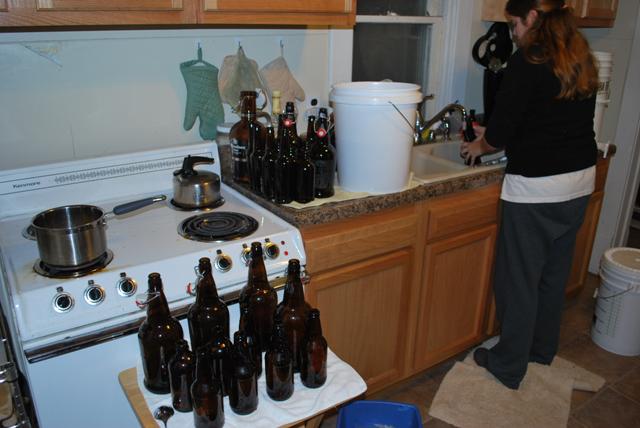
…but first there’s some cleaning to do. It is important to ensure that the bottles and tubing, etc. are completely sterile. Remember that th beer could be sitting for months, if not years, before you drink it – limiting the various critters that could get in there, aside from your yeast, is rather important! You want to limit the soap you add, and you can use bleach or other kinds of cleaners. The key is to rinse very, very, very well! You can’t leave any soap or bleach in there or it’ll kill your yeast, let alone mess with the flavor of the beer!
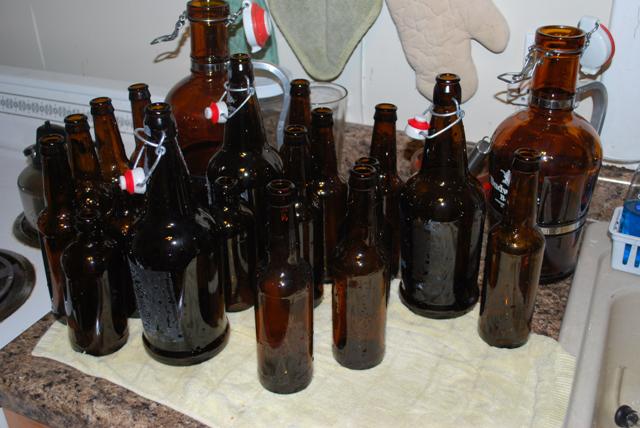
It’s up to you what kinds of bottles you use. The last time I did this, back in undergrad, we used Grolsch bottles almost exclusively because they were 16 oz and had resealable tops, thus alleviating the need for bottle caps. This time, we went with an assortment of bottles with the same kinds of reusable tops, as well as cappable 12 oz bottles. In the image above, you’ll see a few large 2 L bottles, some medium sized 1 L bottles, and then the standard 12 oz bottles. We’ve been saving all of these as we’ve drank beer over the past few months, so that’s a cheap route to go. Just be sure that the bottles you’re saving are not screw cap style, as you can’t re-cap those.
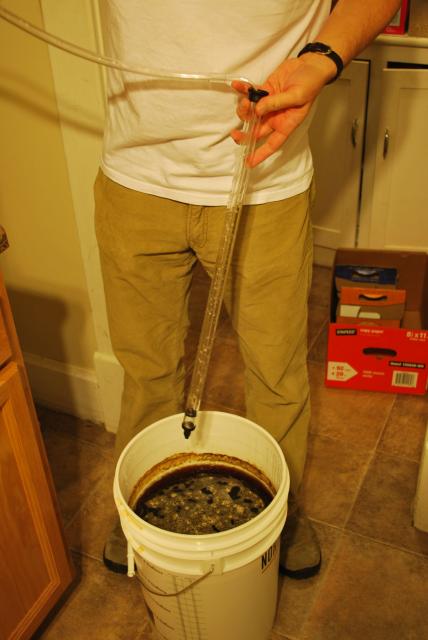
This part can be done in various ways, but the kit from Northern Brewer comes with a nifty little siphon doohicky that you put about 6 in into your beer, pump twice, and beer flows from the fermentation vessel down to the priming vessel.
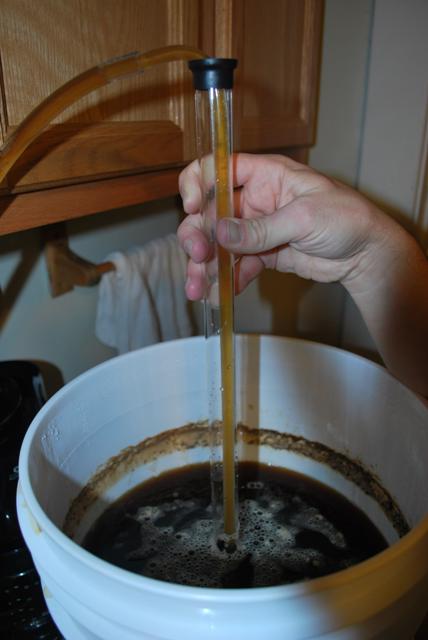
Now, the priming vessel is pretty key. The “priming” aspect of the beer is relating to a few factors. One, there’s a lot of “leftovers” in the fermentation vessel that you wouldn’t really want to drink, so we’re siphoning off the top and leaving the remainder on the bottom. You lose some beer in this, but seriously, you don’t want to drink (or see…) that stuff on the bottom of the bucket… Secondly, in the priming bucket, we also add some more sugar. This is being done to get the yeast active again for a brief period, producing a tad more alcohol. For our purposes, however, it’s the CO2 we care about: carbonation. The sugar we add at the priming stage gives the yeast enough food to continue some fermentation in the individual bottles, thus providing the carbonation we need for the beer. It’s all done naturally.
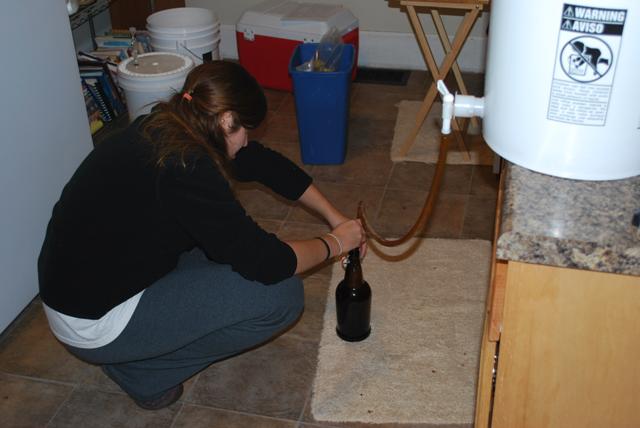 The priming vessel comes with a valve and tubing that you can use to fill bottles with. Really, once you’re at this stage, things go pretty quickly. Also, as the bucket dictates, don’t store your children in 5 gal buckets.
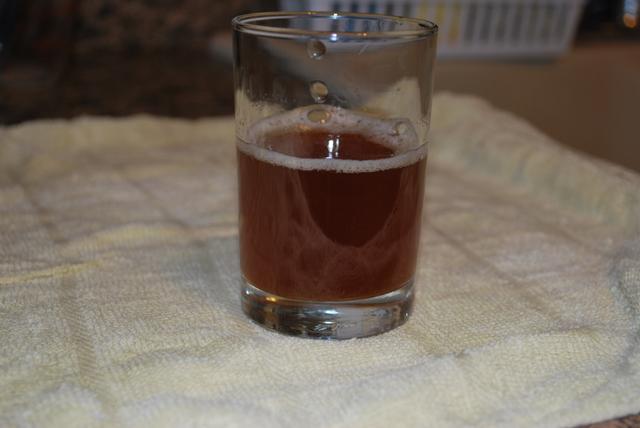
For the record, here’s what our beer looks like after a little over 2 weeks in fermentation. Looks like beer, eh? Tastes like it, too. Granted, no carbonation yet, but it already had characteristic flavors of a nut brown. I tasted it the previous time I checked the specific gravity, which was only two days earlier. I noticed a change in the flavor of the beer just in those two days! In some ways, I probably should have left the beer in the fermenter for an additional week, to let it age a bit more and develop more flavor, but if I wanted to drink it for Thanksgiving, it had to get into bottles. Maybe next time!
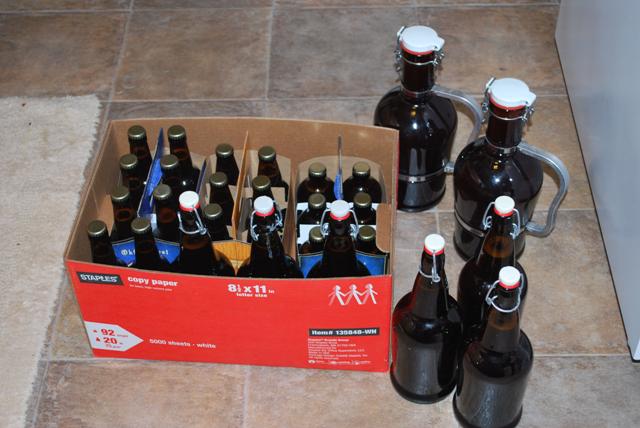
In the end, we bottled two 2 L bottles, six 1 L bottles and twenty 12 oz bottles. Not too bad for $30 and a few weeks of fermentation. 🙂
Primer: Structure of the Brain
These posts, tagged “Primer,” are posted for two reasons: 1). to help me get better at teaching non-scientists about science-related topics; and 2). to help non-scientists learn more about things they otherwise would not. So, while I realize most people won’t read these, I’m going to write them anyway, partially for my own benefit, but mostly for yours.
I can’t say I’ve been excited about writing this one, as brain anatomy is, quite possibly, the most boring thing I can think of to write about. I did a rotation at SLU in a lab that focuses on anatomy and how individual brain structures interact with one another, and that 6 week period was more than enough for me. As that professor told me, it’s very important work that someone needs to do, even if it may not seem all that interesting. This kind of work is how researchers have figured out which brain component “talks” to which other one(s), and how intertwined all these connections really are throughout the brain.
For the sake of this posting, I’ll simply point out that brain mapping has been carried out in a variety of ways. Quite a bit of it has been done over decades when people would hit their heads. If they would lose their memory, or their sense of smell, clinicians could localize the injury to a specific area of the head, then look at the brain post-mortem and see what happened. Ultimately, they would find a lesion of dead tissue in that region that lead to the deficiency. Similarly, the study of stroke victims also provided clues to the function of certain brain locations, as a stroke occurs when blood flow is cut off to an area of the brain, typically leading to damage. Alternatively, modern science uses a series of stereotactic injections of traceable materials in mice, rats and primates that can be visualized in brain slices, showing that a series of neurons in one area are connected with neurons in a separate region of the brain.
It is through this work that certain pathways were elucidated, including the reward pathway (very important for drug addiction, gambling addiction, etc.); the movement pathway (mostly for Parkinson’s disease, but important for voluntary movement, in general); the sensory systems (how the visual cortex signals, the auditory cortex, etc.); the amygdala (figuring out what this structure did and where it went led to quite a few labotomies back in the day); and memory (signals transfered between the hippocampus, the reward system, and the cortex…very complicated network…). It is through brain mapping like this that helped determine where everything connects together, and which areas are important.

While the human brain is a difficult nut to crack, it can be divided up into different portions. For the sake of this little blurb, we’ll focus on the three primary divisions of the brain: the prosencephalon (forebrain), the mesencephalon (midbrain) and the rhombencephalon (hindbrain).
The prosencephalon, or forebrain, is further divided into the telencephalon and the diencephalon. The telencephalon consists, primarily, of the cerebrum, which includes the cerebral cortex (voluntary action and sensory systems), the limbic system (emotion) and the basal ganglia (movement). As you can see from that list, for the most part, the telencephalon is what constitutes what “you” are: your thoughts, your feelings, and your interaction with the world around you. It’s where a lot of your processing happens. The telencephalon in humans is quite a bit more developed than in other species, which is really what separates their brain from other, lesser developed species (i.e. the human telencephalon is what really separates them from a chimpanzee). The diencephalon, on the other hand, consists of the thalamus, hypothalamus and a few other structures. The thalamus and hypothalamus are very important for various regulatory functions, including interpretation of sensory inputs, regulation of sleep, and release of hormones to control eating, drinking, and body temperature.
The mesencephalon is comprised of the tectum and the cerebral peduncle. The tectum is important for auditory and visual reflexes and tends to be more important in non-vertebrates, as they don’t have the developed cerebral cortex that humans do (more on that later). The cerebral peduncle, on the other hand, is a mixed bag of “everything in the midbrain except the tectum.” It includes the substantia nigra, which ties into the movement system and reward system. I think it’s fair to say that, aside from these things, the function of the midbrain, overall, has yet to be fully determined.
The rhombencephalon is quite important, even though it’s probably the oldest part of the brain, from an evolutionary standpoint. It includes the myelencephalon (medulla oblongata) and the metencephalon (pons and cerebellum). The medulla oblongata is important for autonomic functions like breathing and heart function. The pons acts primarily as a relay with functions that tie into breathing, heart rate/blood pressure, vomiting, eye movement, taste, bladder control and more. Finally, the cerebellum is important for a feeling of “equilibrium,” allowing for coordination of movement and action, timing and precision.

As you may have noticed, if you go from back-to-front, you’ll get increasing complexity in brain function. For example, the hindbrain is important for very basic things like breathing, heart rate, and coordinated movement. These are functions that are important in nearly all organisms, but especially so all the way down to the smallest worm and insect. Further up, the mesencephalon starts to work in further control of reward and initiation of voluntary movement, giving the organism voluntary control rather than solely reflexive control. Then, the diencephalon starts acting like a primitive brain, working in regulatory functions and more complicated reflex action to help maintain the more complex organism that has been assembled. And finally, the telencephalon yields the ultimate control over the organism, with things like memory, emotion, and greater interpretation of sensory inputs. As the image above dictates, the hindbrain (to the right-hand side) remains a large portion of the brain in the rat and the cat, but the human forebrain (the top/left-most portion) gets much larger, relative to the hindbrain. With that size comes greater development of brain structure and function.
So yeah, the brain is kinda complicated. Actually, it’s really complicated and, for the most part, I do my best to ignore all of the complex wiring networks that occur within. However, it is important work that needs to be done in order for surgeons to do what they do, and for neuropharmacologists to develop drugs that target some brain areas and not others. For the most part, I’ll leave this research to more interested people…
Of Thanksgiving and Wireless Printers
This year marked our annual trek across Missouri for Thanksgiving, but the first time we’d done so with a nearly 9-month-old. We’ve done this every year since being married, but until now, we’ve only had a dog to deal with. This time, we had a baby…plus the carseat and luggage that goes with her. Needless to say, I’m glad we have a different car now, as all the stuff filled up the back to the point where we couldn’t see out of it any longer.
Regardless, we went to Hannibal for the Thanksgiving holiday where the majority of the Poor/Baumann clan typically goes. Meg did great, for the most part, but didn’t sleep terribly well the second night. As usual, the food was great, the company was fun, and the “Poor Women” entertained me with their video game shenanigans (this year, some fun with “Just Dance 2“…and yes, we have video evidence…). On Friday, we continued our Tour of Missouri by driving to my parent’s house in Columbia where we hung out with the immediate family. Again, Meg did pretty well the first night…and not so well the second night… But overall, again, good food had by all, and a rousing game of Trivial Pursuit on Saturday night.
Either way, it was a pretty good trip. We made it back to Iowa by mid-afternoon, so it allowed us to clean up a bit around here and prep for the upcoming week. Christmas is going to get difficult, I imagine, as we were already pressed for space in the car on this trip. We’ll need to pick up some kind of roof rack bag in order to make space for everything. That, or Edie will have to spend Christmas with Sam… 😛
On a side-note, we didn’t do much Black Friday shopping. I did pick up a few games online, and Brooke and I grabbed a new All-In-One printer from Wal-mart for $44. Great deal. And it works wonders. Wirelessly. It’s glorious. 🙂
And, on another side-note, I was looking to see if the Dave Matthews Band performance from the 2010 Grammy Awards was posted anywhere and, low and behold, it’s up on Youtube. I tried finding it the day after the awards and the only place I could find it was iTunes for $3. Outrageous! Therefore, I post it now. It’s, perhaps, the best live performance of them I have seen and, by far, the best performance of any group at the Grammy’s that night. They should have won.
Step 4: Gravity, oh gravity
So, we selected our beer and we mixed all our ingredients. Periodically, however, we also need to check and see how the fermentation’s going. There are a few things that must be done while your beer is fermenting, ensuring that things are going…”smoothly”…
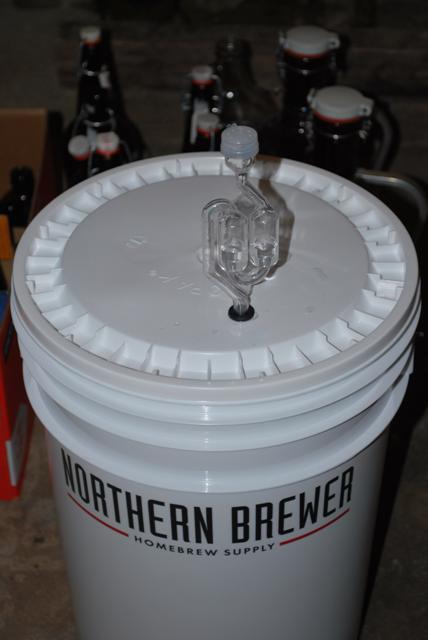
Here’s the fermenting vessel. Nothing too special about it, except for the little trap at the top that contains water. The main purpose for the trap is to show carbon dioxide bubbles escaping from the vessel to the outside of the bucket. If you didn’t have an escape mechanism for the CO2, then you’d blow the thing up in your basement! But more importantly, as long as you see bubbles, you know your yeast is making CO2, and consequently, alcohol.
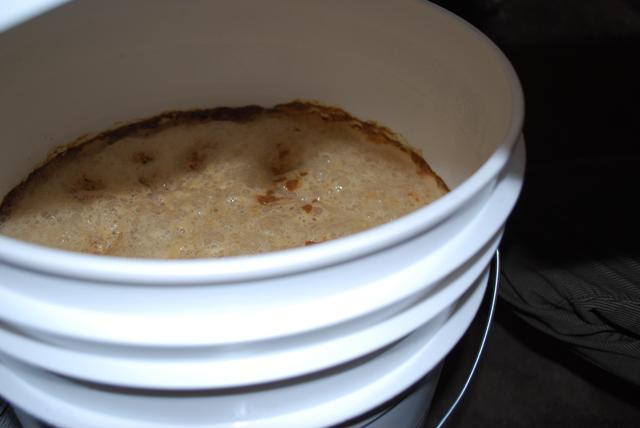
Here’s what your beer should look like, with a nice foam called krausen. This picture was only a few days post-start of fermentation. There should be a few inches of krausen on top of the beer.
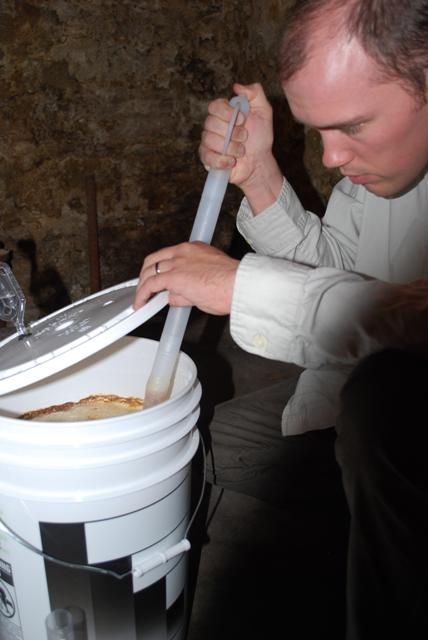
You can use a “thief” to remove a relatively small volume of the beer for testing with limited introduction of contaminants to the brew. You could do this with a ladle or anything else, really, but this little guy is well-suited to removing beer and adding it to…
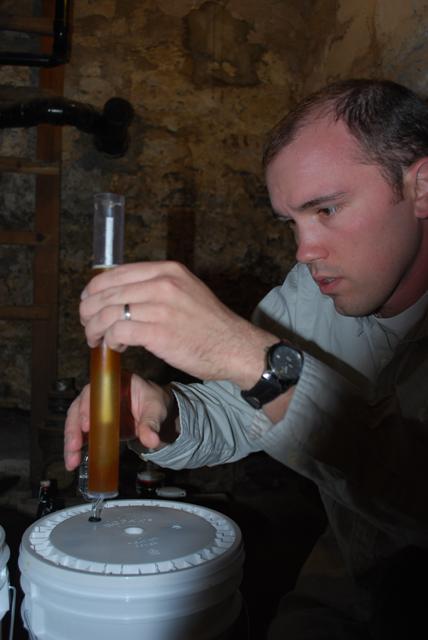
…another vessel that you can test with your hydrometer. The hydrometer is what you use to calculate the alcohol content of your beer, or wine, or whatever. It does this by measuring the density of sugar in a liquid. Since our beer started out as mostly sugar, that means it started at a relatively high “specific gravity,” in this case, 1.050. As the week(s) draw on, the yeast break down the sugar producing alcohol and CO2, thus the specific gravity will decrease as fermentation continues. There’s also a percent alcohol scale on the side of our hydrometer, so you can measure that, too. However, specific gravity is a calibrated system, so you can make adjustments to your numbers based on the temperature the beer was measured in. It’s very easy to use, basically just pouring beer into anything (like the tube it comes with, but a glass of beer would work, too) and allowing the hydrometer to float in it. There are markings on the side of the hydrometer that you read, like a thermometer scale, at the point where the hydrometer exits the beer.
I’m posting this after I checked it for the last time and I’ll go ahead and tell you that it ended at a specific gravity of 1.011. You can run these calculations yourself, generally by subtracting the last one from the first one. Alternatively, you can find a nifty website to do it for you. The numbers off the calculator come out pretty close to what my hydrometer told me: ~5% alcohol. The calculator, however, also estimates that each 12 oz beer will have ~170 calories.
Step 3: Make Some Beer
In the previous post, I showed what some of the equipment looks like, and the various ingredients that go into this particular beer, a Honey Brown, from Northern Brewer. Now we get to put it all to work!
Remember that, prior to this point, we activated, or primed, our yeast and sterilized our equipment. I can’t emphasize this enough: if you don’t have sterile equipment, your beer probably won’t taste right. Many companies sell sterilizing compounds that are rinse-less, but you can always use bleach as well…just make sure you over-rinse the stuff to get rid of any excess bleach.
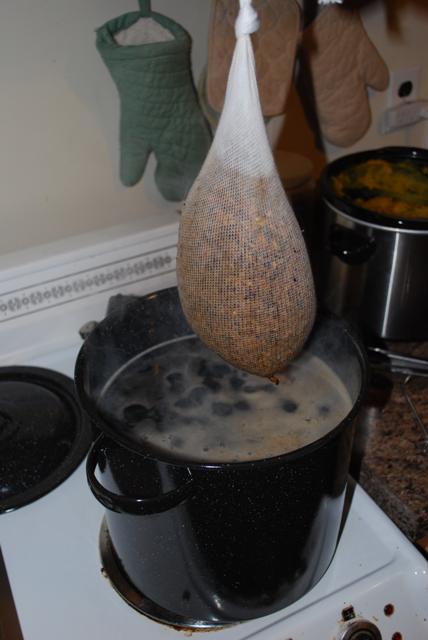
The first step in this kit is to take some of the assorted grains that the kit came with and steep them in a pot for 20 min. You can do this while you heat up the water to boiling. The kit came with assorted grains (including chocolate!) and a cheesecloth to use, so effectively, we’re just making a giant tea bag for your beer. Not all beers come with this kind of addition, but it generally adds some extra flavors to the beer before the malt even sees the water.
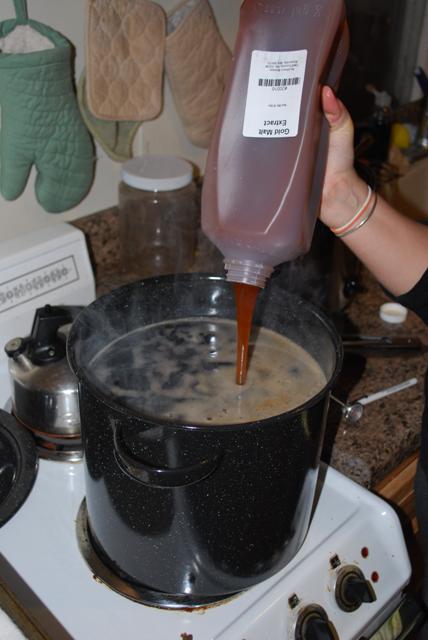
Speaking of the malt, once your water is boiling, you can add the malt to the water. In this black pot, we added about 3 gallon of water, which took quite awhile to boil…but once it does, you can add the malt, which then must be heated at boiling for 60 min. During this time, you can also get a second pot and boil an additional 2 gal (although, I’d boil more than that if you can…) for a total of 5 gal.
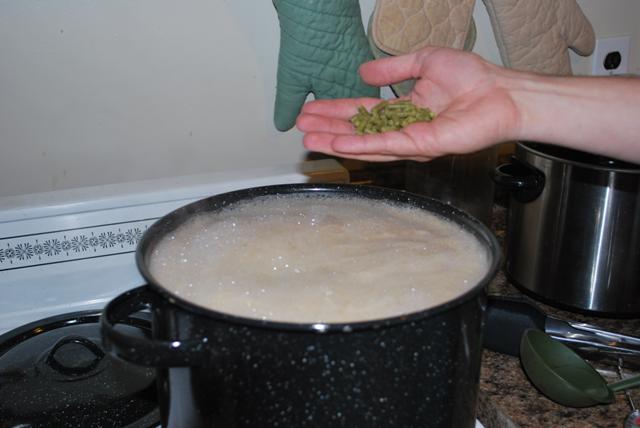
Prior to boiling, you can add your hops. They come in different shapes, but many kits send it in a pellet form that looks a lot like rabbit food. They smell like a good India Pale Ale (a really “hoppy” beer), and you can get different varieties of hops to bring out different flavors in your beers. Regardless, they usually go in prior to the 60 min boil, but you can add “finishing hops” at the bottling stage. This kit doesn’t include any finishing hops, though.
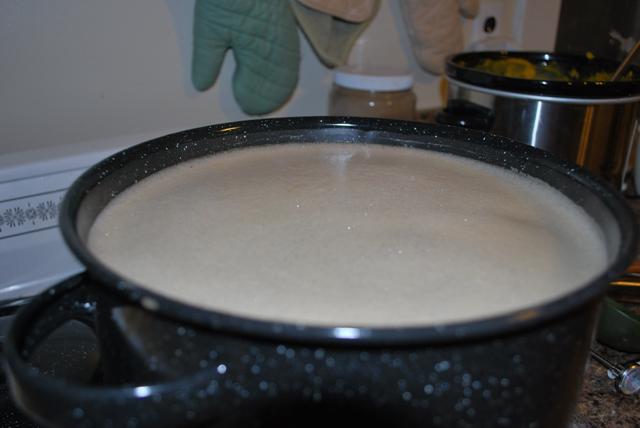
As it heats, you’ll notice a foam forming on the top. This stuff is pretty sticky, so it behooves you to watch the pot as it boils (I know, right?). You don’t want it to boil over, ’cause this foamy stuff will overflow into your range…and it’s a pain to clean up, and the smell from it is also difficult to get rid of. So yeah, keep an eye on it – don’t go watch a show or anything! [Note: This particular batch didn’t boil over, but back in undergrad, we boiled them over many times…bad news…]
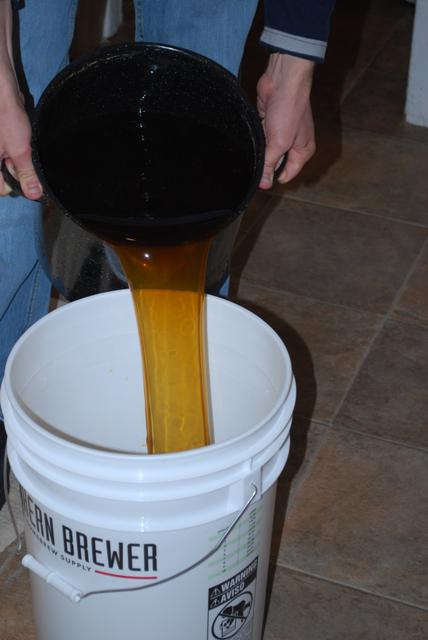
After you boil your beer (and another pot of water…), you need to wait for it to cool down. Think about that. You are waiting for 5 gal of liquid to cool down from boiling (~212 F) to…um…colder than that (~78 F) so you can add your yeast. This can take awhile. Even in Iowa when it’s 40 F outside, it still took forever, so I recommend using an ice water bath to help cool down the beer faster. You want this to occur as fast as possible. The longer you wait, the more likely you’ll get various critters and infections in there to mess with your beer.
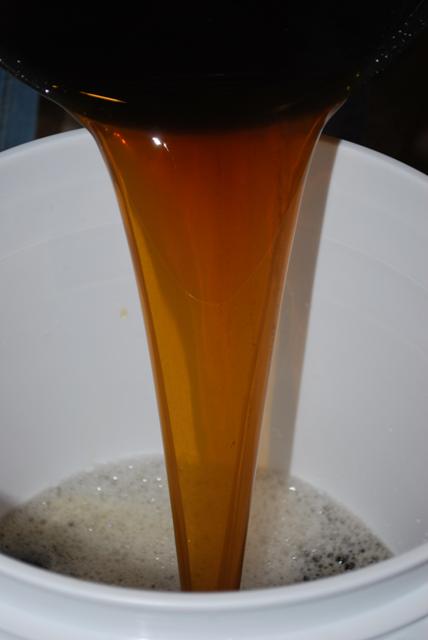
Pretty color! You’ll pour it all into the bucket and then add any additional water to get it to 5 gal. It’s, of course, preferable to sterilize (i.e. boil) all water that goes in the bucket, which is why it’s probably best to boil the additional 3 gal rather than 2 gal, as you’ll lose volume over the hour that you’re boiling everything. Always best to boil some excess if you’ve got the space for it!
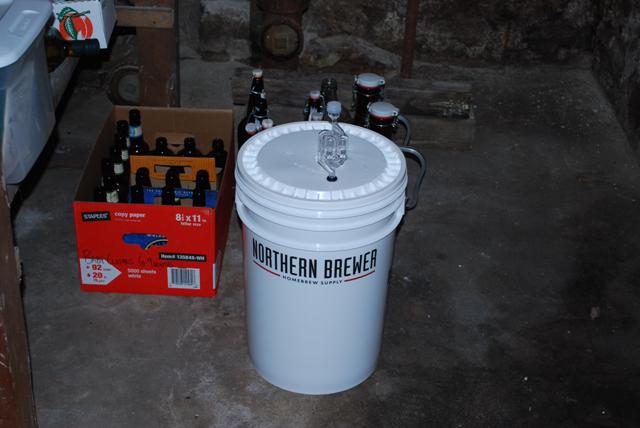
Finally, you seal ‘er up and put the trap on the top along with a small volume of water and move it to its home for the next few weeks. We are putting our beer in our basement, which is usually at an ambient temperature of 55 F (so far, even with the furnace running 20 feet away…). Now, 55 F is a touch chilly for the recommended temperature for our yeast (recommends 60 – 75 F or so), but within a few days, the bubbling had begun.
Speaking of “bubbling,” that’s what the trap on the top is for. It’s got two little reservoirs with water in it that allows for CO2 to escape from the fermentation bucket while preventing other things from getting in. It’s kinda shaped like the plumbing pipe beneath your bathroom sink. Basically, in order to know that fermentation is occurring without popping the top of the bucket (assuming you don’t have a glass carboy, which I’m not using presently…), you can see bubbles flow through the water in the trap. You should see this within 48 hours of adding yeast to your fermentation bucket – if you don’t, you probably need to move it to a warmer place, but thankfully, 55 F was “good enough” for my purposes.
In the next post, we’ll check the “specific gravity” of the beer, helping us approximate how much alcohol is being generated. You usually do this a few days to a week after starting the fermentation process, and you try to limit the times you do this ’cause you have to actually open the seal at the top, potentially introducing invaders to your beer.