Scrambled eggs, fried potatoes, and bacon. Pretty boring, but the internet taught me that if you cook the potatoes in the microwave (like baked potatoes) for awhile before you chop them up and fry them, you get a much better fried potato/hashbrown!

10.06.12 Lunch
Pizza boats! Well, fancy ones on Companion pretzel bread. Andy’s school lunch history did not contain pizza boats. He was missing out!!

10.01.12 Dinner
Meatloaf, mashed potatoes, and fruit salad with some too tart yogurt.

09.28.12 Lunch
I love fall cooking! Tomato soup, grilled cheese with apples and Dijon mustard, and chips. Perfect lunch before going to unload pumpkins!

Empiricism vs Rationalism

As part of the grant I’m on at work, I am expected to attend “continuing ethics training” each year. Last Wednesday was the first of two sessions, each a little over an hour long, and I ended up presenting a case study to the other folks in the room regarding the way science is conducted and how it is perceived by the general public. This past Wednesday, however, we had a guest speaker in the form of Stephen Lefrak, a pulmonary physician that also has research interests in medical ethics.
He covered a range of subjects, but he specifically highlighted a series of studies he was involved with over 10 years ago, studies published in the New England Journal of Medicine, among other high profile journals. Studies funded by the NIH and carried out by the National Emphysema Treatment Trial Research Group (NETT). These studies involved a surgical procedure for patients with emphysema, where portions of the lung with damaged tissue would be removed, and the rest of the lung (presumably healthy tissue) would be restructured to form a better-functioning respiratory organ. Lefrak and his colleague here at Wash U were involved early on with the trial, but left after they had serious ethical concerns, one of which centered on the idea of a “randomized controlled trial (RCT).”
For the sake of simplicity, an RCT is essentially the idea that you apply one of two (or more) potential treatments to a given individual, and that individual is selected at random from a given group. In this case, the treatment was the surgical removal of lung tissue (presumably damaged) in order to refashion a healthier lung, and the group was emphysema patients. However, and importantly, it was known at the time that you can’t just do this to someone that has lung damage spread throughout the lung: it only works if there is healthy tissue still in there to salvage.
Lefrak knew it wouldn’t work if the trials were carried out at random (i.e. paying no attention to the quality of the patients lungs, or whether they had healthy lung tissue remaining, or whether they had a “homogeneous” mix of damaged and undamaged tissue). However, when this concern was raised in the pages of NEJM, he was essentially told that he couldn’t “know” it because an RCT had not been done to prove it.
As a result, almost 50% of the patients it was tried on ended up dying, for the very reason Lefrak and colleagues warned them about.
Which brings us to the title of this post: empiricism vs rationalism. “Empiricism” is what drives the belief that an RCT is essential to making the claim that this kind of lung surgery is “dangerous” to a subset of individuals. “Rationalism” is behind the idea that we actually know things about how the body works and can make an informed inference as to what the outcome would be without having to do the RCT to “prove” it.
The example Lefrak gave is that an RCT to prove that you need a parachute to jump out of a plane would be silly. We already know the answer.
As Lefrak talked about his experience, it got me thinking about where our knowledge comes from and how we build upon it. Whether I concern myself, personally, with “evidence” more than I should, without thinking rationally about a particular subject in order to come to a conclusion. I’d consider myself to be a “rational” person, but perhaps not. Then again, as he described what the surgery was seeking to do, my physiology training assured me that I would have been on his side from the beginning, rather than advocating the continuation of the NETT work.
It’s just something we, as scientists, ought to consider more often than we typically do, I guess.
Another New Toy!
After more than 7 years of coveting a stand mixer and an anxiety attack in the kitchen store, I finally broke down and was willing to spend the money for a Kitchenaid mixer. I thought I wanted the standard classic in a lime green finish, but after some more research decided that the higher powered one would suit my needs for longer. So far, it’s made several batches of cookies, whipped cream, mashed potatoes, multiple loaves of bread, hamburger buns, and some beeswax lotion. Hooray!!!

09.15.12 Sweets
Post apple-picking treats:
Caramel apples!

Caramel-mocha lattes with the leftover caramel from the apples:

09.04.12 Dinner
Sorry for the long break in posts! More to follow after this one!
Italian sausage with peppers and onions!

Pedometer Experiment Revisited
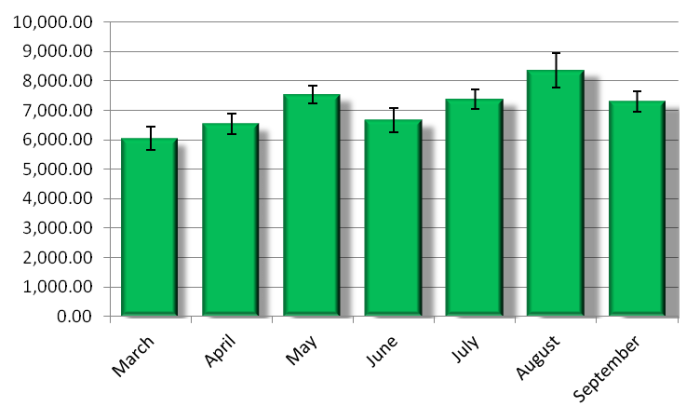
Back in February, we thought it would be helpful to get an idea of just how much physical activity we were getting on a daily basis at work and at home. As of this weekend, I completed 6 months of data collection and figure I can stop wearing a pedometer for awhile.
As a reminder, most literature suggests you try to get to 10,000 steps/day, which is approximately 5 mi of walking. We were able to achieve that on some days, but generally speaking, we were below that on average. Still, part of the reason to do this in the first place is to know just how much walking you’re doing and whether you’re even close to where you “should” be.
I should note that Brooke wore hers through mid-June and then switched off to an Android app that allows you to keep track of calorie intake. Between March and mid-June, her average number of steps was 6,388.7 each day. These charts only reflect data collected on me (my “global” average for the 6 months was 7,078.7 steps/day).

I separated out the data by month to help paint a clear picture of where that “7,078.7” comes from. You’ll see that my activity level was a little less in the colder months of the year, while activity increased during the warmer months of the year. I haven’t subdivided it all out, but my activity on weekends varied widely, where some days I’d be lucky to hit 4000 steps (yay, couch and TV days!) and others I’d clear 12,000 steps (mowing, working outside, going to the park, etc).
Case-in-point, my “most active” day was August 24th, with 15,631 steps. On that day, we were in Minnesota and visited the Mall of America…twice.
Overall, I’m glad the data suggest that I’m “trending upwards” on my walking each month, though I’m sure it will just go down again as it gets colder. My monthly average is probably accurate for a given year. While 10,000 steps/day is ideal, I can’t say I’m all that disappointed with 7,000 steps/day as a daily average.
Though, it would have been interesting to wear a pedometer back when I was spending 2 hrs each week mowing the lawn up in Iowa…
Note: We were pretty busy last month with a variety of things, so sorry we haven’t posted anything since, uh, early September! Got more on the way. 🙂
08.27.12 Dinner
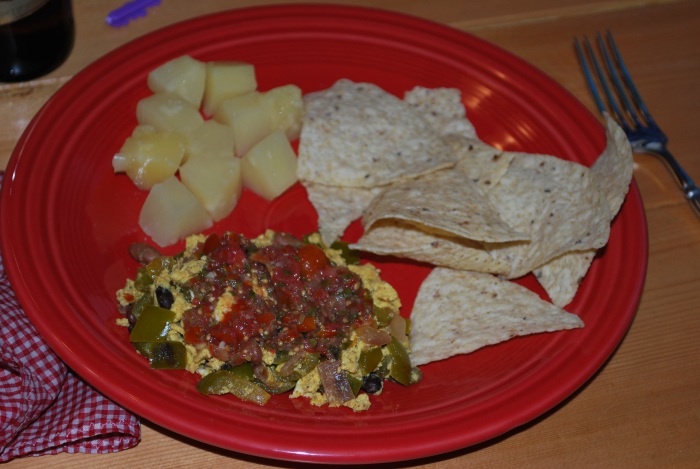
Home again, home again… Breakfast nachos and pineapple.